How to Calculate Profit Margin and Price for the Margin You Want
Profit margin tells you how much of every sale you actually keep. Learn the formula, the difference between gross, operating and net margin, and how to set a price that hits a target margin.

Revenue is the number people like to talk about, but margin is the number that pays the bills. A shop that sells 100,000 a year at a 10% margin keeps 10,000 before overheads; one that sells half as much at a 40% margin keeps twice that. If you sell anything, from handmade candles to consulting hours, knowing your margin, and how to price for it, is one of the most useful skills you can have.
What profit margin measures
Profit margin is profit expressed as a share of the selling price:
Margin = (price − cost) ÷ price × 100
It answers the question "out of every 100 a customer pays me, how much is profit?" A 25% margin means you keep 25 of every 100 and the other 75 covers the cost.
A worked example
You make scented candles. Wax, wick, jar, fragrance and label cost 18 per candle, and you sell each one for 45.
- Profit: 45 − 18 = 27
- Margin: 27 ÷ 45 × 100 = 60%
- Markup, for comparison: 27 ÷ 18 × 100 = 150%
Both percentages describe the same 27 profit. Margin compares it with the price, markup compares it with the cost. Margin is the figure accountants, lenders and investors use, so it is worth thinking in margin even if you set prices with a markup.
Gross, operating and net margin
The margin above is the gross margin: it only subtracts the direct cost of the product itself. A real business has other costs, and each layer gives a different margin. Imagine your candle business has a month like this:
- Revenue: 20,000
- Cost of goods sold (materials): 8,000, leaving a gross profit of 12,000, a 60% gross margin
- Operating costs (workshop rent, packaging, website, card fees, your part-time helper): 7,000, leaving an operating profit of 5,000, a 25% operating margin
- Interest and taxes: 1,500, leaving a net profit of 3,500, a 17.5% net margin
All three are correct; they just answer different questions. Gross margin tells you whether each product is priced well. Operating margin tells you whether the business as a whole is run efficiently. Net margin is what is finally left for the owner. A 60% gross margin can still end in a loss if overheads are high, which is why checking only the product margin can be dangerously reassuring.
Pricing for a target margin
Often you know the margin you want and need the price. Rearranging the formula gives:
Price = cost ÷ (1 − target margin)
For a 35% margin on the 18 candle: 18 ÷ 0.65 = 27.69. The profit is 9.69, and 9.69 ÷ 27.69 is indeed 35%.
The tempting shortcut is to add 35% to the cost: 18 × 1.35 = 24.30. That is a 35% markup, but the margin is only 6.30 ÷ 24.30 ≈ 25.9%. On a hundred candles that gap is more than 300 of profit you thought you had.
The higher the target margin, the faster the required price climbs. To earn a 50% margin, you need a 100% markup. For 70% you need a markup of about 233%, and for 80% the price has to be five times the cost.
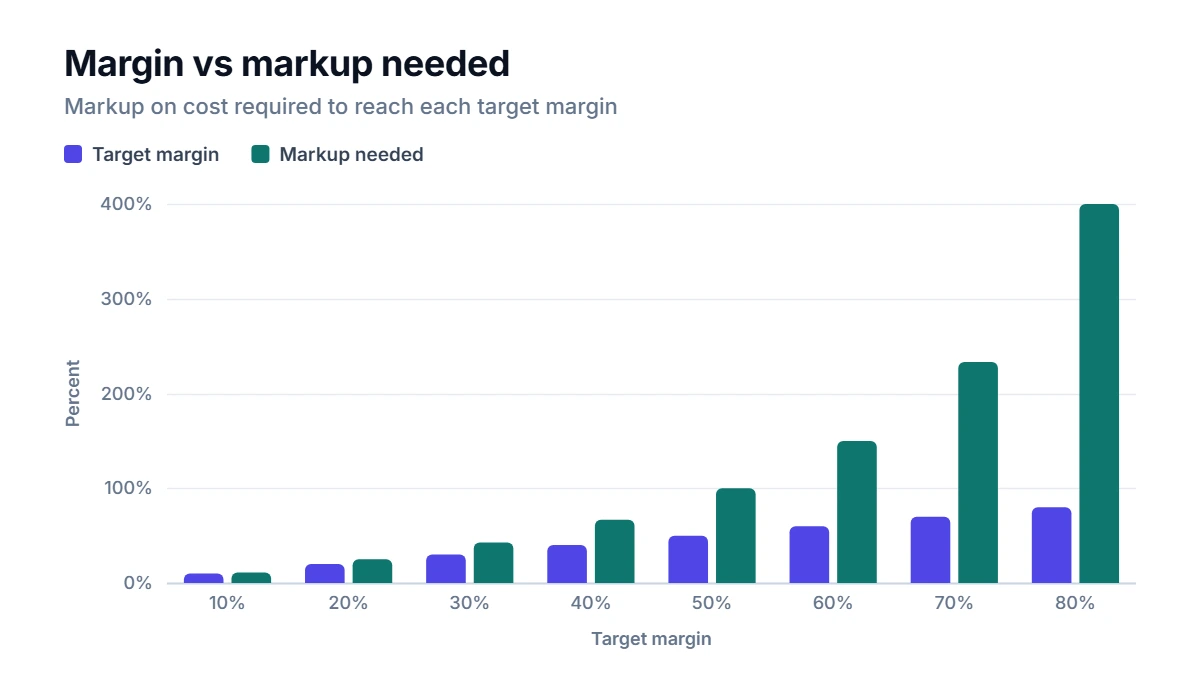
This is also why a margin can never reach 100%: the price would have to be infinite, or the cost zero.
How discounts eat into margin
A discount comes straight out of your profit, not out of your cost, so it hurts margin more than people expect. Take the 45 candle again and run a 20% off sale:
- Sale price: 45 × 0.80 = 36
- Profit: 36 − 18 = 18
- Margin: 18 ÷ 36 = 50%
A 20% discount cut your profit per candle by a third, from 27 to 18. To earn the same total profit you would need to sell 1.5 times as many candles. Before running a promotion, check how much extra volume it has to bring in just to break even with your normal prices.
How to use the Profit Margin Calculator
Choose what you already know. With cost and revenue the Profit Margin Calculator shows the gross profit, the margin and the markup of something you already sell. With cost and margin it finds the price that hits your target margin, and with cost and markup it finds the price after adding a markup. Every result lists all five figures side by side, so you never confuse margin with markup. Run your own products through it once, and you will quickly see which ones carry the business and which ones barely pay for themselves.
Good-to-know tips
- Get the real unit cost. Include everything that goes into one unit: materials, packaging, inbound shipping and payment fees per sale if they scale with each order.
- Know your industry's range. A grocery store working on thin margins and a software company with very high gross margins can both be healthy. Compare yourself with similar businesses, not with a single "good" number.
- Review prices when costs change. If your material cost rises from 18 to 21 and the price stays at 45, the margin falls from 60% to about 53%. Small cost increases add up.
- Leave tax out. Sales tax or VAT collected from the customer is not revenue you keep, so calculate margin on the price before tax.
The results are planning estimates, not financial or tax advice. Check current tax rules for your business.
FAQ
Is a 50% profit margin good?
As a gross margin for a handmade or specialty product it is often healthy, because it leaves room for overheads. As a net margin it would be exceptional for most businesses. Always say which margin you mean.
How do I calculate margin when I sell services?
Use the direct cost of delivering the service as the cost: contractor fees, materials, or your own hours valued at the wage you would otherwise pay someone. The formula is the same, price minus cost divided by price.
Why did my margin go down when I raised prices and sales grew?
Check whether your costs rose too, for example through extra shipping, overtime or bulk orders with bigger discounts. Margin depends on both sides of the sale, and growth often brings new costs with it.
What is contribution margin?
It is the price minus all the costs that change with each sale, such as materials, packaging and card fees. What is left contributes to fixed costs like rent and then to profit. It is the key input when you work out how many units you must sell to break even.
