How to Calculate Your Running Pace
Work out your pace from a race time, turn a goal time into a pace to hold, and see how a few seconds per kilometer add up to minutes over a half marathon or marathon.

Pace is the number runners live by. It is the time it takes you to cover one kilometer or one mile, written like a clock: 5:30 per km means five minutes and thirty seconds for every kilometer. Knowing your pace lets you plan a race, set a training effort and turn a goal time into something you can actually feel on the road.
Pace versus speed
Speed and pace describe the same thing from opposite sides. Speed says how far you go in a fixed time (10.9 km/h). Pace says how long a fixed distance takes (5:30 per km). Runners prefer pace because race distances are fixed and the question is always "how long will this take?"
A lower pace number is faster. Dropping from 6:00 to 5:30 per km is an improvement of 30 seconds per kilometer.
The three formulas
Distance, time and pace are tied together. If you know any two, you can find the third:
- Pace = time ÷ distance
- Time = pace × distance
- Distance = time ÷ pace
The only tricky part is that times are written in minutes and seconds, which are not decimals. The safe approach is to turn everything into seconds first, do the arithmetic, and turn the answer back into minutes and seconds at the end.
A fully worked example
You ran a 10K in 55:00. What was your pace?
- Convert the time to seconds: 55 × 60 = 3,300 seconds.
- Divide by the distance: 3,300 ÷ 10 = 330 seconds per km.
- Convert back: 330 seconds is 5 minutes and 30 seconds, so 5:30 per km.
- For miles, multiply by 1.609344 (the number of kilometers in a mile): 330 × 1.609344 ≈ 531 seconds, or 8:51 per mile.
- Your speed is 3,600 ÷ 330 ≈ 10.91 km/h, or about 6.78 mph.
Now flip it around. If you could hold that same 5:30 per km for a half marathon (21.0975 km), your time would be 330 × 21.0975 ≈ 6,962 seconds, or 1:56:02. For a full marathon (42.195 km) it would be 3:52:04. In practice most runners slow down over longer distances, so treat these as best-case numbers.
Turning a goal time into a pace
Goal times are where pace really helps. Say you want to run a marathon in under 4 hours.
- 4 hours is 14,400 seconds.
- 14,400 ÷ 42.195 ≈ 341 seconds per km, so you need about 5:41 per km, or 9:09 per mile.
That gives you a number to check every kilometer marker. Running 5:40 per km would bring you home in about 3:59:06, so running just over a second per kilometer quicker than the break-even pace leaves almost a minute of margin.
The same goal pace also gives a 2:00:00 half marathon, because the half is exactly half the distance. A sub-4 marathon and a sub-2 half need the same pace.
How small pace changes add up
A few seconds per kilometer sounds tiny, but over a long race it becomes many minutes. Here are finish times at different steady paces:
- 4:30 per km: half 1:34:56, marathon 3:09:53
- 5:00 per km: half 1:45:29, marathon 3:30:59
- 5:30 per km: half 1:56:02, marathon 3:52:04
- 6:00 per km: half 2:06:35, marathon 4:13:10
- 6:30 per km: half 2:17:08, marathon 4:34:16
- 7:00 per km: half 2:27:41, marathon 4:55:22
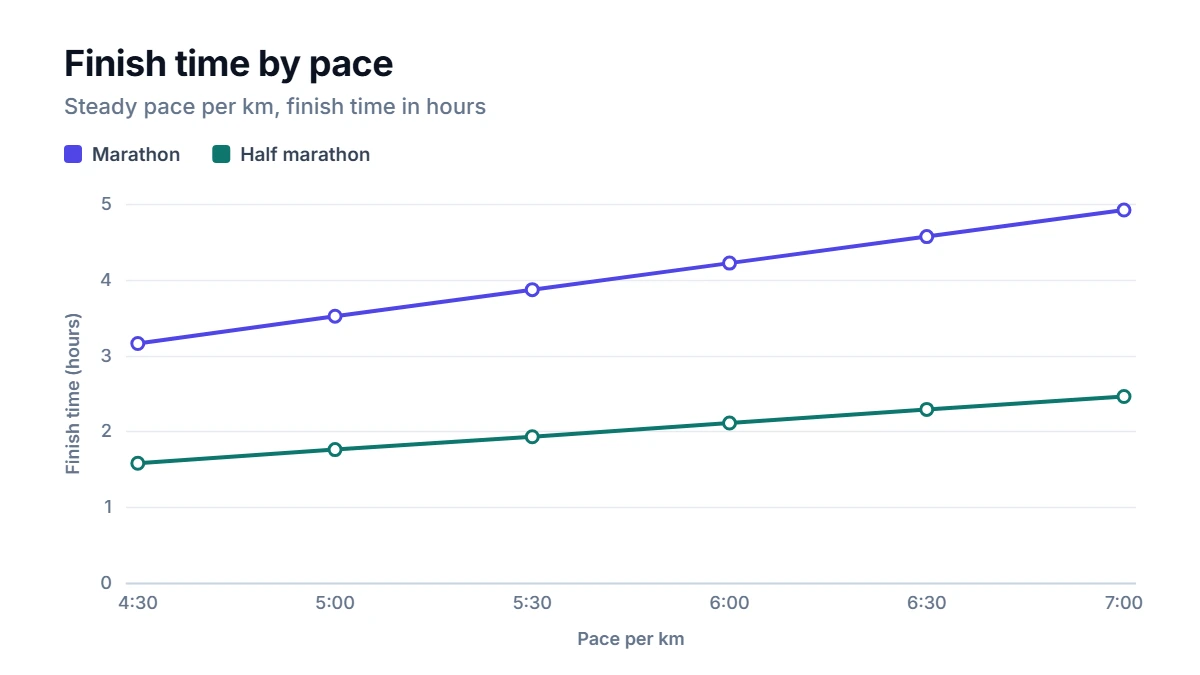
Every 30 seconds per km is worth about 10.5 minutes over a half marathon and about 21 minutes over a marathon.
Finding a distance from a time
The third formula is handy for training runs. If you have 45 minutes and run at an easy 6:15 per km, how far will you go? 45 minutes is 2,700 seconds, and 2,700 ÷ 375 = 7.2 km, or about 4.47 miles.
How to use the Pace Calculator
The Pace Calculator works in all three directions:
- Choose what you want to find: Pace, Time or Distance.
- Pick a race distance (5K, 10K, half marathon, marathon or 1 mile) or enter a custom distance in kilometers or miles.
- Enter the time in hours, minutes and seconds, and/or the pace in minutes and seconds per km or per mile.
- Press Calculate. The result shows the answer plus the pace in both min/km and min/mi and the speed in km/h and mph.
Use it before a race to set your target splits and after a race to see what pace you actually held.
Good to know
- Even pacing is usually fastest. Starting much quicker than your goal pace tends to cost more time later than it saves early. Many runners aim for even splits or a slightly faster second half.
- GPS watches read a little long. Courses are measured along the shortest legal line, and you rarely run it perfectly. Your watch may show 42.6 km at the end of a marathon. Plan to run a few seconds per kilometer faster than the exact goal pace.
- Conditions change the effort. Heat, wind, hills and altitude all slow you down at the same effort. Adjust the goal rather than forcing the pace.
- Training paces differ from race pace. Easy runs are often one to two minutes per kilometer slower than race pace, and that is normal.
- Do not mix decimals and clock time. 5.5 minutes is 5:30, not 5:50. When in doubt, convert to seconds.
FAQ
How do I estimate my marathon time from a shorter race?
A common rough rule is that pace slows by a few percent each time the distance doubles, so a 10K time does not simply double for a half marathon. Use a recent race result as a guide, add a margin, and check it against your long training runs.
What is a good beginner running pace?
Beginners often run between 6:30 and 8:00 per km, and any pace you can hold while still talking in short sentences is a good easy pace. Your pace will improve with steady training; there is no single correct number.
How do I convert a treadmill speed into a pace?
Divide 60 by the speed. A treadmill set to 10 km/h gives 60 ÷ 10 = 6 minutes per km. At 6 mph it is 10 minutes per mile.
Why do my kilometer splits vary so much on the same run?
Hills, turns, crowds and GPS signal all change the split for a single kilometer. Look at the average pace over the whole run and at how it felt, rather than at any one split.