How to Calculate Volume: Boxes, Cylinders, Cones and Spheres
How many liters does that tank hold, and how much soil fills a planter? Learn the volume formulas for everyday shapes, how to turn the result into liters or gallons, and why small size changes have big effects.

Volume is the amount of space a solid takes up, or the amount a container can hold. It answers questions like how much water fills an aquarium, how much concrete a slab needs or how much soil to buy for a raised bed. Most real objects are close to a handful of basic shapes, and once you know how those formulas fit together, you can estimate almost anything.
The core idea: base area times height
For any shape with straight sides and the same cross-section all the way up, volume is the area of the base times the height. Stack identical thin layers and you get the whole solid.
- Box (rectangular prism): the base is a rectangle, so
V = length × width × height. - Cube: all edges are equal, so
V = a³. - Cylinder: the base is a circle, so
V = πr² × h. - Triangular prism: the base is a triangle, so
V = triangle area × length.
Because volume multiplies three lengths, the unit is cubed. Centimeters give cubic centimeters, feet give cubic feet.
Pointed shapes hold one third
A cone or a pyramid narrows to a tip, so it holds less than the cylinder or box with the same base and height. The exact share is one third: V = ⅓ × base area × height. For a cone that is ⅓πr²h; for a rectangular pyramid, ⅓ × l × w × h.
A sphere sits neatly between the two. Take a cylinder whose height equals its width, and fit a sphere and a cone inside it. The volumes are in the ratio 1 : 2 : 3 for cone, sphere and cylinder. With a radius of 10 cm and a height of 20 cm:
- Cone: about 2,094 cm³, or 2.09 liters
- Sphere: about 4,189 cm³, or 4.19 liters
- Cylinder: about 6,283 cm³, or 6.28 liters
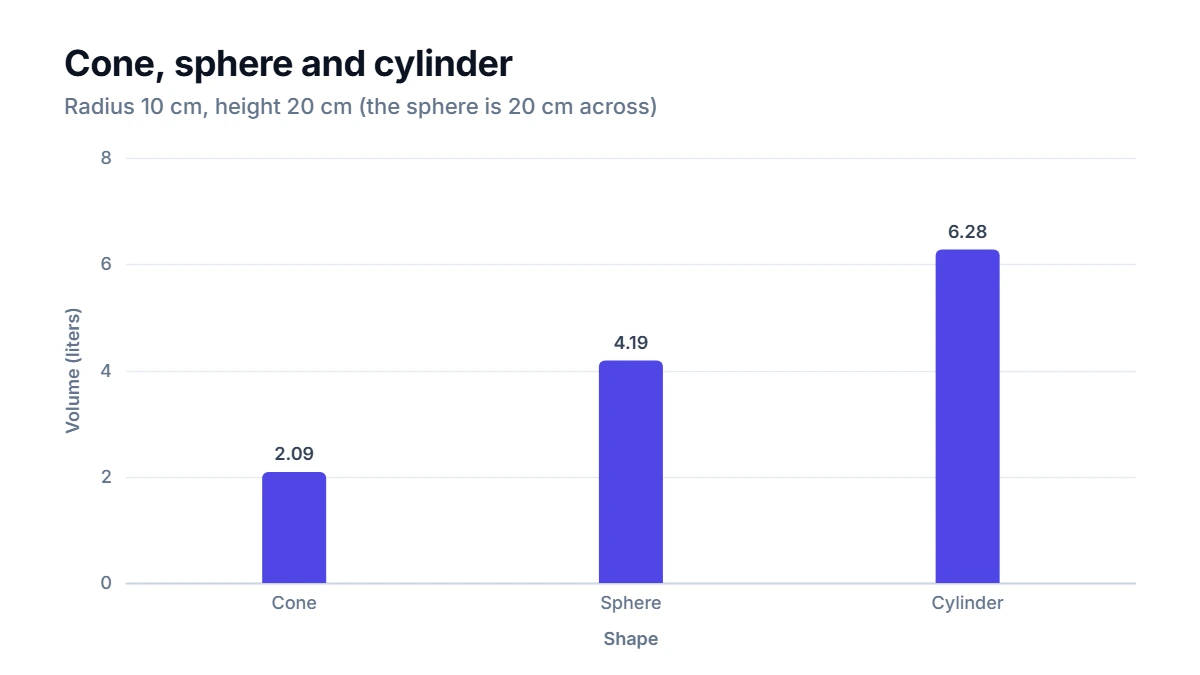
The sphere formula, V = ⁴⁄₃πr³, follows from that ratio: two thirds of the cylinder πr² × 2r.
Worked examples around the house
An aquarium. A tank measures 80 cm long, 35 cm wide and 40 cm tall on the inside. Its volume is 80 × 35 × 40 = 112,000 cm³. Since 1,000 cm³ is one liter, it holds 112 liters when filled to the brim. In practice you fill it a few centimeters short and gravel takes up space, so the real amount of water is lower.
A rain barrel. A cylindrical barrel has an inside diameter of 60 cm, so the radius is 30 cm, and it is 120 cm tall. The volume is π × 30² × 120 ≈ 339,292 cm³, or about 339 liters.
A bucket. Buckets are wider at the top than at the bottom, which makes them a frustum, a cone with its tip cut off. With a bottom radius of 15 cm, a top radius of 20 cm and a height of 30 cm, the formula V = ⅓πh(R² + Rr + r²) gives about 29,060 cm³, or roughly 29 liters. Treating it as a plain cylinder with the top radius would give 37.7 liters, almost a third too much.
A concrete slab. A patio slab of 4 m by 3 m, 10 cm thick, is 4 × 3 × 0.1 = 1.2 cubic meters. Convert the thickness to meters before multiplying; 4 × 3 × 10 would give 120, which is meaningless. Suppliers usually add some extra for spills and uneven ground, so check their advice.
Size changes are cubed
Because three lengths are multiplied, volume reacts strongly to size. Double every edge of a 10 cm cube and the volume jumps from 1,000 cm³ to 8,000 cm³, eight times as much. Even a small change matters: a ball with a radius of 11 cm instead of 10 cm is only 10% wider, but it holds about 5,575 cm³ instead of 4,189 cm³, a third more.
This works in reverse, too. A container that looks "half as big" at a glance often holds only about an eighth, because each of its three dimensions is halved.
How to use the calculator
Choose a shape in the Volume Calculator and enter the measurements it asks for, all in the same unit. Press Calculate to get the volume and the surface area, with every step written out. If you measured in centimeters, divide the cubic-centimeter result by 1,000 for liters; if you measured in meters, multiply cubic meters by 1,000. For gallons, quarts or cubic feet, put the result into a volume converter.
Common mistakes
- Measuring the outside. For a container, use inside dimensions. Thick walls can take a surprising share of the space.
- Mixing units. A 2 m by 50 cm by 30 cm box must be entered as 200, 50 and 30 cm, or 2, 0.5 and 0.3 m.
- Using the slant height of a cone. The height in the formula is the straight vertical distance from the base to the tip.
- Confusing volume and surface area. Volume tells you how much goes inside; surface area tells you how much material covers the outside, such as paint or wrapping.
FAQ
How do I find the volume of an irregular object?
Submerge it in a container of water and measure how much the water level rises. The volume of the displaced water equals the volume of the object. For a measuring jug, read the liters directly; for a box-shaped tank, multiply the rise by the length and width.
How do I work out the volume of a partly filled tank?
For a box-shaped or upright cylindrical tank, use the depth of the liquid as the height. For a cylinder lying on its side, the filled part is not a simple shape, so a dedicated tank calculator or a manufacturer's chart is more accurate.
How many liters are in a cubic meter?
Exactly 1,000. A cube 1 meter on each side holds 1,000 liters, which is why water usage and concrete orders are often quoted in cubic meters.
Why does a tall, thin glass look like it holds more than a wide one?
Our eyes judge height more than width. But width counts twice in the volume, because the radius is squared. A glass twice as wide holds four times as much at the same height, so the wide one often wins.
