How to Convert Kilograms to Pounds (and Other Weight Units)
The exact link between kilograms and pounds, quick ways to convert in your head, how stones and ounces fit in, and why the word "ton" can mean three different weights.

Weight is one of the few measurements where most people live with two systems at once. A recipe from one country uses grams, a bathroom scale shows pounds, luggage limits are in kilograms and a friend in the UK talks about stones. The good news is that all of these units are tied together by a single exact number, so converting between them is always precise. This guide explains that link, gives quick mental methods and covers the units that most often cause confusion.
The one number behind it all
Since 1959, the pound has been defined by the kilogram:
1 lb = 0.45359237 kg exactly
Every other imperial unit is a fixed multiple of the pound, so they all inherit the same precision:
- 1 ounce = 1/16 lb = 28.349523125 g
- 1 stone = 14 lb = 6.35029318 kg
- 1 US short ton = 2,000 lb
- 1 UK long ton = 2,240 lb
The metric side is simpler still: 1,000 mg = 1 g, 1,000 g = 1 kg, and 1,000 kg = 1 metric tonne.
Converting kilograms to pounds
Divide by 0.45359237, or multiply by about 2.20462. Both give the same answer.
- 68 kg ÷ 0.45359237 ≈ 149.914 lb
- 2.5 kg ÷ 0.45359237 ≈ 5.512 lb
Converting pounds to kilograms
Multiply by 0.45359237.
- 150 lb × 0.45359237 = 68.0388555 kg exactly
- 4 lb × 0.45359237 = 1.81436948 kg
Because the definition goes from pounds to kilograms, pounds to kilograms always gives an exact result with a fixed number of decimals, while kilograms to pounds produces an endless decimal that has to be rounded.
Quick mental shortcuts
When you need a rough figure in a shop or a gym:
- kg to lb: double it and add 10%. 68 kg doubled is 136, plus 10% (13.6) gives 149.6 lb. The real answer is 149.9.
- lb to kg: halve it and take away 10%. 150 lb halved is 75, minus 7.5 gives 67.5 kg. The real answer is 68.04.
- Ounces to grams: multiply by 28, then add a little. 12 oz × 28 = 336 g; the exact value is 340.19 g.
- Grams to ounces: divide by 28. 500 g ÷ 28 ≈ 17.9 oz; the exact value is 17.64 oz.
These are good to within about 1–2%, which is fine for cooking or checking a bag, but not for medicine doses or anything that must be exact.
Handy reference points
A few anchors make it easier to sense whether a converted number is reasonable:
- A 1 kg bag of sugar is about 2.2 lb.
- A standard stick of butter in the US is 4 oz, or about 113 g.
- A 5 lb bag of flour is about 2.27 kg.
- A 20 kg weight plate is about 44.1 lb, and a 45 lb plate is about 20.4 kg.
- One metric tonne, about the weight of a small car, is about 2,205 lb.
If your answer is far from these, check whether you multiplied when you should have divided.
Stones and pounds
In the UK and Ireland body weight is often given in stones and pounds, such as 11 st 4 lb. To convert:
- Turn stones into pounds: 11 × 14 = 154 lb.
- Add the extra pounds: 154 + 4 = 158 lb.
- Convert to kilograms: 158 × 0.45359237 ≈ 71.668 kg.
Going the other way, divide pounds by 14. 158 ÷ 14 = 11.2857 stones; the whole number is 11 stones, and 0.2857 × 14 = 4 pounds.
Ton, tonne and long ton
"Ton" is the most confusing word in weight. It can mean three different amounts:
- US short ton: 2,000 lb, or 907.18474 kg
- Metric tonne: 1,000 kg, or about 2,204.62 lb
- UK long ton: 2,240 lb, or 1,016.0469088 kg
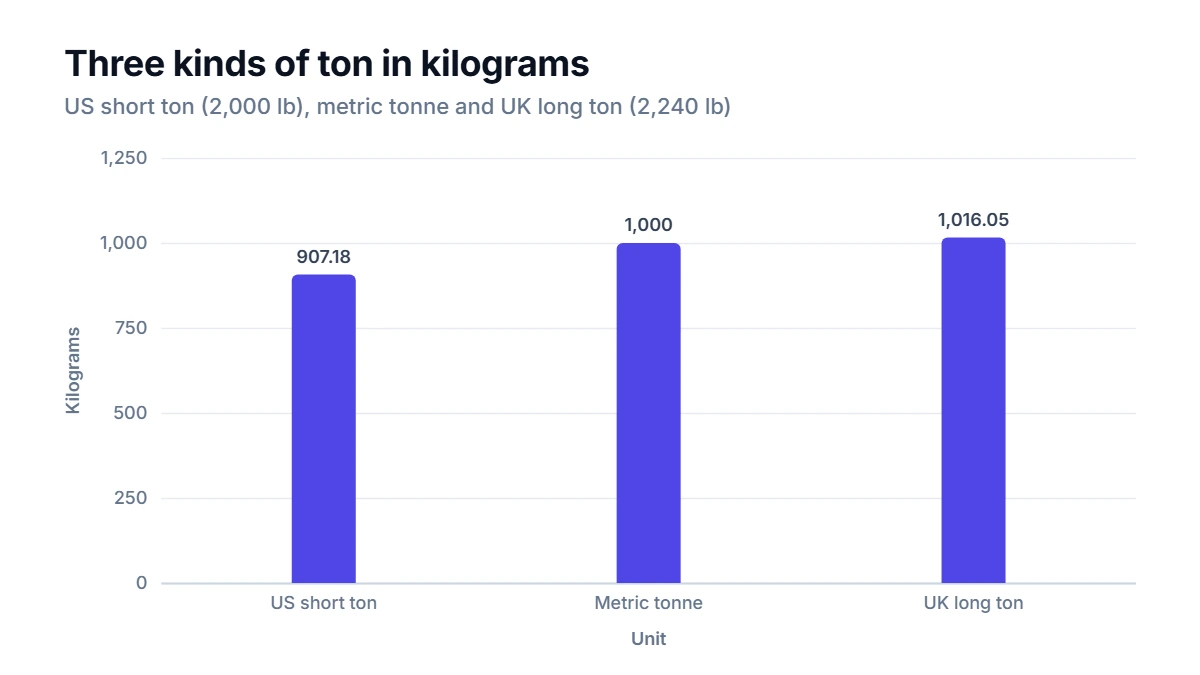
The difference between a short ton and a long ton is more than 100 kg, which matters for freight, building materials and vehicle limits. When a document just says "ton", check which one is meant. International trade and science almost always use the metric tonne.
How to use the Weight Converter
Type a value, choose the unit you have and the unit you want, and press Convert. The Weight Converter shows the answer and a table with the same weight in milligrams, grams, kilograms, metric tonnes, ounces, pounds, stones, US short tons and UK long tons. The swap button reverses the direction, which is handy for checking a result. For stones and pounds, convert the total in pounds, or enter the stones as a decimal such as 11.2857.
Good to know
- Weight and mass. Scales report mass, and that is what these units measure. Strictly speaking, weight is a force, but in everyday life the words are used the same way.
- Troy ounces are different. Gold and silver are priced in troy ounces of about 31.1 g, heavier than the everyday 28.35 g ounce.
- Fluid ounces are volume. A fluid ounce measures liquid volume, not weight. For water it is close to an ounce of weight, but for oil, honey or flour it is not, so use a volume or cooking converter for those.
- Round at the end. Keep full precision through a calculation and round only the final figure. Rounding 0.4536 early and then multiplying by a large number can add noticeable errors.
FAQ
How many pounds is 100 kilograms?
About 220.46 lb. Divide 100 by 0.45359237, or use the shortcut: double 100 to get 200 and add 10% to get 220.
Why does my luggage limit say 23 kg or 50 lb?
They are close but not identical: 23 kg is about 50.7 lb and 50 lb is about 22.68 kg. Airlines round to a neat number in each system, so stay a little under whichever limit applies to you.
How many grams is a pound?
453.59237 g exactly, which is often rounded to 454 g on food labels.
What is half a stone?
Seven pounds, or about 3.18 kg. People in the UK often talk about losing "half a stone".

