How to Convert MPG to L/100 km (and Back)
Why liters per 100 km works upside down compared with miles per gallon, how US and UK gallons differ, and the mpg illusion that makes some upgrades look better than they are.

Fuel economy is one of those numbers that changes its meaning when you cross a border. An American car review says 30 mpg, a British one says 36 mpg for the same car, and a German brochure says 7.8 L/100 km. All three describe exactly the same efficiency. Once you understand the two ideas behind them, the different gallons and the "upside down" metric unit, converting between them takes seconds.
Two ways to measure the same thing
Fuel economy units fall into two families:
- Distance per fuel: miles per gallon (mpg), kilometers per liter (km/L) and miles per liter. They answer "how far do I get on one unit of fuel?" Higher is better.
- Fuel per distance: liters per 100 kilometers (L/100 km). It answers "how much fuel do I need to cover a fixed distance?" Lower is better.
Most of Europe, Australia and many other countries use L/100 km. The United States uses US mpg, the United Kingdom still quotes imperial mpg on cars even though fuel is sold in liters, and countries such as Japan and India commonly use km/L.
Because the two families are reciprocals of each other, converting between them is a division, not a multiplication. That is the step people most often get wrong.
The conversion step by step
Every conversion rests on three exact definitions:
- 1 mile = 1.609344 km
- 1 US gallon = 3.785411784 liters
- 1 UK (imperial) gallon = 4.54609 liters
From US mpg to L/100 km:
- Convert miles per gallon into kilometers per liter: multiply by 1.609344 and divide by 3.785411784. That is the same as multiplying by about 0.425144.
- Turn distance per fuel into fuel per distance: divide 100 by the km/L figure.
Combining both steps gives a single constant: L/100 km = 235.215 ÷ US mpg. For UK mpg the constant is 282.481, because the imperial gallon is larger. The same formula runs backward too: US mpg = 235.215 ÷ L/100 km.
Worked example: comparing two cars across the Atlantic
Imagine you are choosing between a car rated 35 mpg (US) in an American review and one rated 6 L/100 km in a European review.
- Car A: 235.215 ÷ 35 ≈ 6.72 L/100 km.
- Car B: 6 L/100 km, or 235.215 ÷ 6 ≈ 39.20 mpg (US).
Car B is the more efficient of the two. Over 10,000 km it uses about 600 liters, while car A uses about 672 liters.
Now add a British review that rates car A at 42 mpg. That looks better than 35, but it is the same car: UK mpg is roughly US mpg × 1.201, and 35 × 1.201 ≈ 42.03. Always check which gallon a figure uses before you compare.
Why L/100 km gives a fairer picture
Distance-per-fuel numbers hide how much fuel you actually save. Look at what a car uses over 100 miles at different mpg ratings:
- 15 mpg → 6.67 gallons
- 20 mpg → 5.00 gallons
- 30 mpg → 3.33 gallons
- 40 mpg → 2.50 gallons
- 50 mpg → 2.00 gallons
Moving from 15 to 20 mpg saves 1.67 gallons per 100 miles. Moving from 40 to 50 mpg, a bigger jump on paper, saves only 0.5 gallons. Researchers call this the mpg illusion: people tend to overvalue gains at the efficient end and undervalue replacing a really thirsty vehicle.
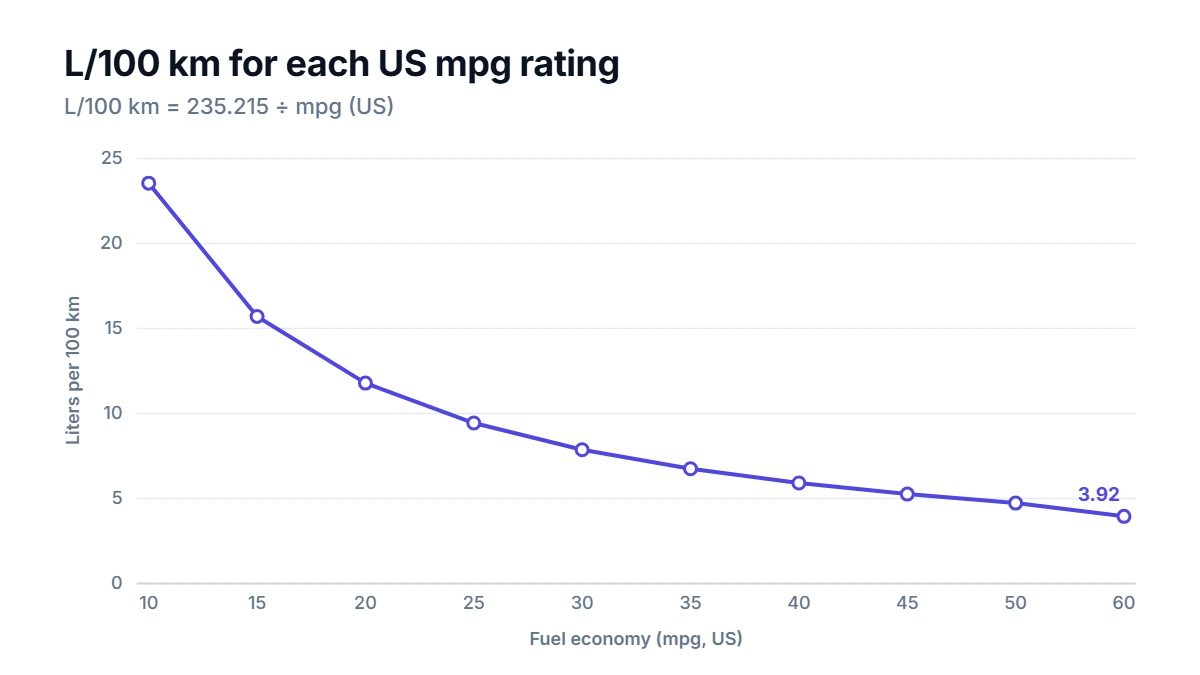
Fuel-per-distance units do not have this problem. Every 1 L/100 km saved is the same amount of fuel, whether you go from 15 to 14 or from 5 to 4. The curve below shows how L/100 km changes with US mpg: steep at the left, almost flat at the right.
How to use the converter
The Fuel Economy Converter takes one figure and shows it in all five units at once. Type the number into the Value box, choose its unit (US mpg, UK mpg, km/L, L/100 km or miles per liter) and press Convert. The headline shows the most useful counterpart, L/100 km for distance-based units or US mpg when you start from L/100 km, and the list below gives the rest, rounded to two decimals.
Quick reference values from the converter:
- 20 mpg (US) = 11.76 L/100 km = 24.02 mpg (UK)
- 30 mpg (US) = 7.84 L/100 km = 12.75 km/L
- 40 mpg (US) = 5.88 L/100 km = 48.04 mpg (UK)
- 5 L/100 km = 47.04 mpg (US) = 56.50 mpg (UK)
- 10 L/100 km = 23.52 mpg (US) = 28.25 mpg (UK)
Mental shortcuts
You will not always have a converter at hand. Two rough rules get you close:
- US mpg to L/100 km: divide 235 by the mpg. For 25 mpg, 235 ÷ 25 ≈ 9.4.
- UK to US mpg: take off a sixth. 48 UK mpg minus 8 is 40 US mpg. The exact factor is 0.8327.
Common mistakes
- Multiplying instead of dividing. 30 mpg is not 30 × 0.425 L/100 km. That gives km/L (12.75), which is a different unit. You still need to divide 100 by it.
- Mixing US and UK gallons. The imperial gallon is about 20% larger, so UK mpg figures always look better.
- Averaging mpg values directly. If you drive one tank at 20 mpg and an equal distance at 40 mpg, your average is not 30 mpg. Over 200 miles you used 5 + 2.5 = 7.5 gallons, so the average is 200 ÷ 7.5 ≈ 26.7 mpg. Averaging L/100 km values over equal distances works correctly.
- Comparing official figures from different regions. US, European and other ratings come from different test cycles. Converting the unit does not convert the test, so expect some gap even after a perfect conversion.
FAQ
Is 6 L/100 km good fuel economy?
For a gasoline car it is fairly efficient: about 39 US mpg or 47 UK mpg. Small hybrids can do better and large SUVs usually do worse. What counts as good depends on the vehicle class, so compare like with like.
How do I convert km/L to mpg?
Multiply km/L by 2.352 for US mpg or by 2.825 for UK mpg. For example, 15 km/L is about 35.3 mpg (US). To get L/100 km from km/L, divide 100 by the figure: 15 km/L is about 6.67 L/100 km.
How do I measure my own car's fuel economy?
Fill the tank, reset the trip meter, drive normally and fill up again. Divide the distance by the fuel you added for mpg or km/L, or divide the fuel by the distance and multiply by 100 for L/100 km. Averaging over several tanks smooths out filling differences.
Do electric cars have an mpg figure?
Some labels show an "mpg equivalent" that converts electricity into the energy content of a gallon of gasoline. More practical figures for an EV are kWh per 100 km or miles per kWh, which work like L/100 km and mpg respectively.


