How to Convert a Salary to an Hourly Wage
Turn any pay rate into any other: annual to hourly, hourly to monthly, bi-weekly to yearly. See why longer hours lower a salary's real hourly rate and how unpaid weeks change the picture.

Job offers are quoted in different units. One posting says 60,000 a year, another says 28 an hour, and a third pays 2,400 every two weeks. You cannot compare them until they are in the same unit, and the conversion is easy once you know how many hours, days and pay periods are hiding inside a year.
Why the conversion matters
An hourly figure tells you what your time is worth. An annual figure tells you what you can plan around. Converting between them helps when you:
- compare a salaried role with an hourly or contract role
- check whether a raise or a promotion with longer hours really pays more per hour
- turn a paycheck amount into a monthly budget
- decide whether overtime-free salary is better than hourly pay with paid overtime
All the figures in this guide are gross pay, before taxes, social security, retirement contributions and other deductions. Take-home pay depends on where you live, so check current rules for your own deductions.
The method: go through the year
The cleanest way to convert any pay rate into any other is to turn it into an annual amount first, then divide by the number of periods you want.
- Find the annual pay. Multiply the amount by the number of those periods in a year.
- Divide by the target period. Divide the annual pay by the number of target periods in a year.
The number of periods in a year depends on the period:
- Hours: hours per week × weeks worked. A standard 40-hour week for 52 weeks is 2,080 hours.
- Days: days per week × weeks worked, so 260 for a five-day week.
- Weeks: weeks worked, usually 52.
- Bi-weekly: weeks worked ÷ 2, so 26 paychecks.
- Semi-monthly: always 24 (twice a month).
- Monthly: 12. Quarterly: 4.
Notice that the first four depend on your schedule, while the last ones are fixed parts of the calendar. That is why a salary's monthly amount never changes when your hours do, but its hourly equivalent does.
A fully worked example
You are offered a 60,000 salary for a 40-hour week, and the job pays you for all 52 weeks, including vacation.
- Hourly: 60,000 ÷ (40 × 52) = 60,000 ÷ 2,080 = 28.85
- Daily: 60,000 ÷ 260 = 230.77
- Weekly: 60,000 ÷ 52 = 1,153.85
- Bi-weekly: 60,000 ÷ 26 = 2,307.69
- Semi-monthly: 60,000 ÷ 24 = 2,500.00
- Monthly: 60,000 ÷ 12 = 5,000.00
Now compare that with an hourly job paying 22 for a 37.5-hour week. If you are paid for all 52 weeks, that is 22 × 37.5 × 52 = 42,900 a year, or 3,575 a month. If the job has four weeks of unpaid time off, you are paid for 48 weeks instead, and the annual figure falls to 39,600, or 3,300 a month. The hourly rate did not change, but the yearly income dropped by 3,300.
Longer hours lower your real hourly rate
A fixed salary is paid for the job, not for the hours. If the role regularly runs past 40 hours, the hourly equivalent goes down. Here is what a 60,000 salary is worth per hour at different weekly hours, over 52 weeks:
- 35 hours: 32.97 an hour
- 37.5 hours: 30.77
- 40 hours: 28.85
- 45 hours: 25.64
- 50 hours: 23.08
- 55 hours: 20.98
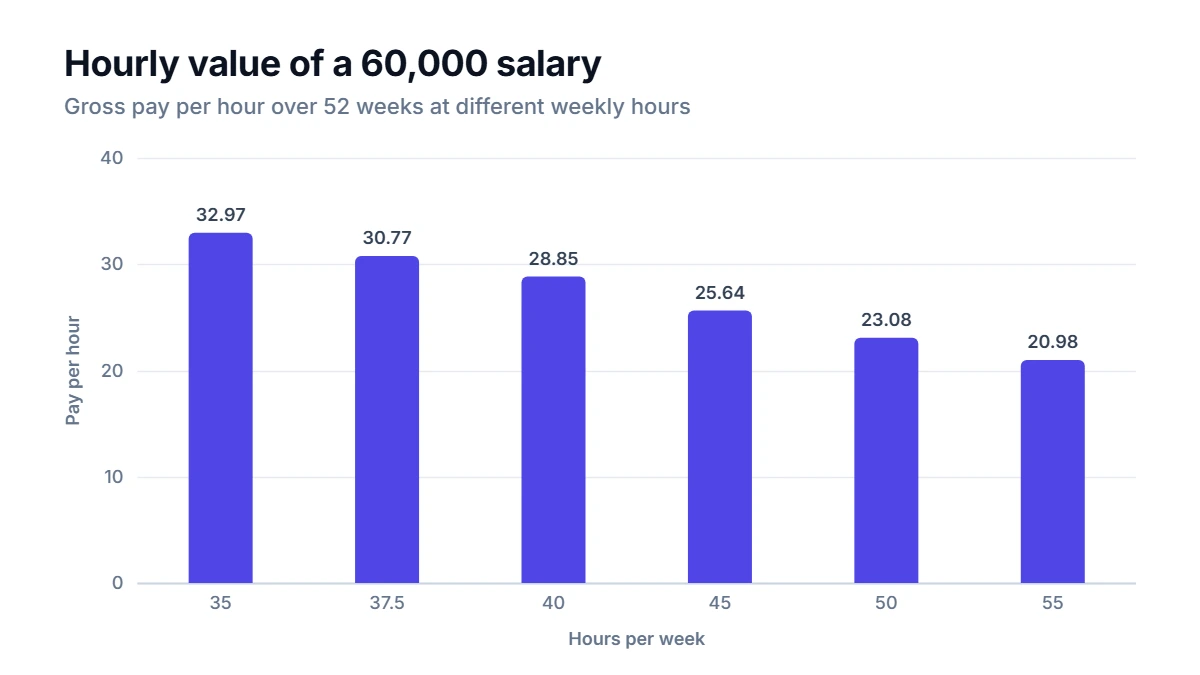
At 50 hours a week, a 60,000 salary pays about the same per hour as a 23-an-hour job at 40 hours. Be honest about the hours you actually expect to work when you compare offers.
Bi-weekly versus semi-monthly
These two sound alike but are different. Bi-weekly pay arrives every two weeks, which is 26 paychecks in a typical year. Semi-monthly pay arrives twice a month, which is 24 paychecks.
The same 60,000 salary gives a bi-weekly check of 2,307.69 or a semi-monthly check of 2,500.00. If you see a bi-weekly check of 2,500, the annual pay is 2,500 × 26 = 65,000, not 60,000. For budgeting, bi-weekly pay has a nice side effect: two months a year contain a third paycheck.
How to use the Salary Calculator
The Salary Calculator does the whole table at once:
- Enter the gross pay amount and choose the period it covers, for example Year or Hour.
- Check the work schedule: hours per week, days per week and weeks worked per year.
- Press Calculate. You get the equivalent pay for every period, with the one you entered highlighted.
Lower the weeks worked per year if you take unpaid time off or work seasonally. For a salaried job with paid vacation, leave it at 52, because you are paid for those weeks too.
Common mistakes and good-to-know
- Assuming a month is four weeks. Four weeks is 28 days, but the average month is about 4.33 weeks. Multiplying a weekly wage by 4 understates monthly income by roughly 8%. Go through the year instead: weekly × 52 ÷ 12.
- Using 2,000 hours as a shortcut. It is a handy round number (50 weeks × 40 hours), but it assumes two unpaid weeks. If you are paid all year, 2,080 is more accurate.
- Ignoring benefits. Health cover, retirement matching and paid leave can be worth a lot. Two offers with the same hourly equivalent are not always equal.
- Forgetting overtime rules. Hourly workers may earn a higher rate for extra hours; salaried workers often do not. The rules depend on your job and location, so check current rules.
- Comparing gross with net. Make sure both numbers you compare are before tax, or both after.
FAQ
How do I convert an hourly wage to a monthly income quickly?
Multiply the hourly rate by your weekly hours, then by 52, then divide by 12. For 22 an hour at 37.5 hours a week: 22 × 37.5 × 52 ÷ 12 = 3,575 a month before tax. The shortcut "hourly × hours × 4.33" gives almost the same answer.
Does a raise in hourly pay or a raise in salary go further?
Neither, on its own. Convert both jobs to the same unit with your real hours and weeks, then compare. A higher salary with ten extra hours a week can be worth less per hour than a lower one.
Should I include paid holidays in the weeks worked?
Yes, if they are paid. Weeks worked per year really means weeks you are paid for. Only leave out weeks that bring no pay at all.
What hourly rate should I charge as a freelancer to match a salary?
Start from the salary's hourly equivalent, then raise it to cover unpaid days, gaps between projects, your own equipment and the benefits an employer would have paid. Many freelancers bill fewer hours than they work, so plan with billable hours, not total hours.
