How to Convert Time Between Time Zones
Converting time zones is easy once you go through UTC, but daylight saving dates trip people up. Learn a simple two-step method, worked examples and tips for scheduling meetings.

Converting a time from one time zone to another sounds like simple addition, and most of the year it is. The trouble comes from daylight saving time, which shifts clocks on different dates in different countries, and from the date line, which can turn your Tuesday afternoon into someone else's Wednesday morning. This guide shows a reliable method you can do by hand, then explains the traps that catch people out.
The one idea that makes it easy: go through UTC
Every time zone is defined as an offset from Coordinated Universal Time (UTC). New York is UTC−5 in winter, Tokyo is UTC+9 all year, and India is UTC+5:30. Instead of memorizing the difference between every pair of cities, convert in two steps:
- Turn the source time into UTC by subtracting the source offset.
- Turn UTC into the target time by adding the target offset.
A negative offset subtracted becomes an addition, so 10:00 at UTC−5 is 10:00 + 5 hours = 15:00 UTC. Then 15:00 UTC in Tokyo (UTC+9) is 15:00 + 9 = 24:00, which is midnight at the start of the next day.
The only thing you must get right is which offset applies on that specific date, because daylight saving time changes it.
A worked example: a call from Chicago
You are in Chicago and want to schedule a call for 10:00 on Wednesday, October 28, 2026. Chicago is still on daylight time (UTC−5) because the United States does not switch back until November 1. Europe, however, already switched on October 25, so London is on UTC±0.
Step 1: 10:00 at UTC−5 is 15:00 UTC.
Step 2: apply each target offset on that date:
- London (UTC±0): 15:00, Wednesday
- Berlin (UTC+1): 16:00, Wednesday
- Kolkata (UTC+5:30): 20:30, Wednesday
- Tokyo (UTC+9): 00:00, Thursday October 29 (+1 day)
- Sydney (UTC+11): 02:00, Thursday October 29 (+1 day)
The Time Zone Converter gives the same results, along with the 12-hour form, the weekday and the day change for each row.
The same call one week later
Now move the call to 10:00 on Wednesday, November 4, 2026. Chicago has fallen back to standard time, UTC−6, so 10:00 in Chicago is now 16:00 UTC. London shows 16:00, Kolkata 21:30 and Sydney 03:00 on Thursday. Nothing changed in London, India or Australia, yet every one of those times moved an hour later, because only Chicago's offset changed. This is why a recurring meeting can suddenly land an hour off for some participants.
Why the gap between two cities changes during the year
Because countries change their clocks on different dates, the difference between two cities is not fixed. New York and London are usually 5 hours apart, but the United States switches to summer time about three weeks before Europe in spring, and switches back one week after Europe in autumn. During those weeks the gap is only 4 hours.
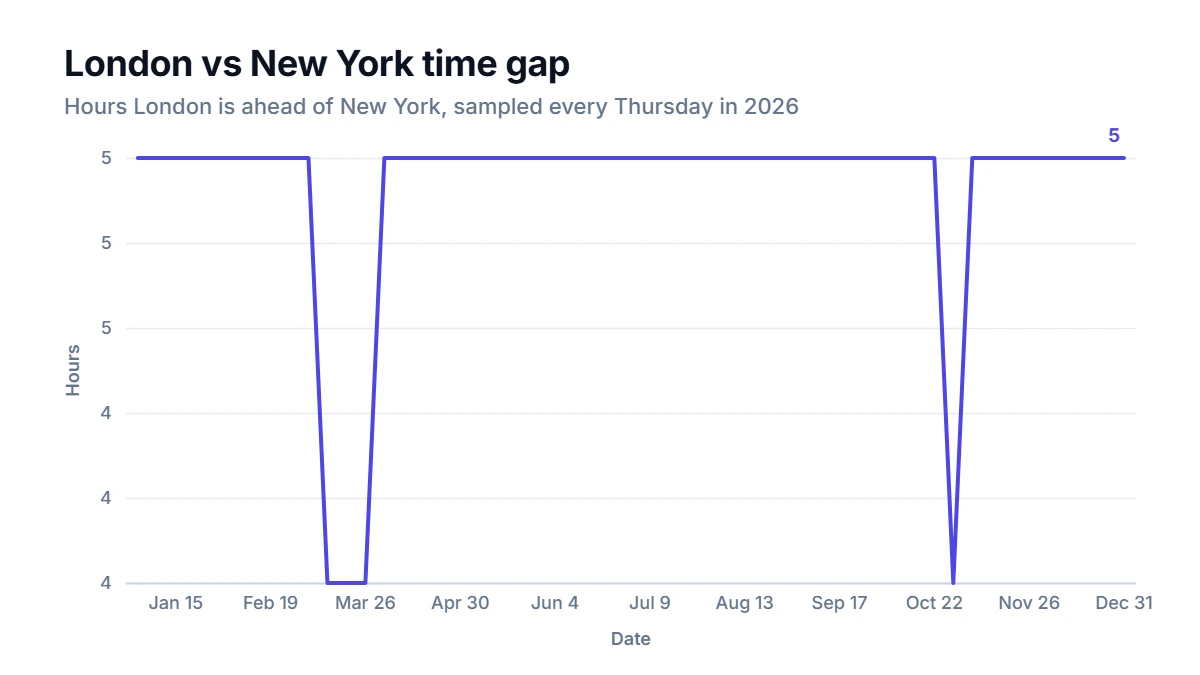
Countries in the southern hemisphere make it more confusing still, because their summer time runs during the northern winter. The gap between London and Sydney swings by two hours over the year.
Daylight saving gaps and repeated hours
Twice a year, local clocks do something odd:
- Spring forward. In London on Sunday, March 29, 2026, clocks jump from 01:00 straight to 02:00. A time like 01:30 simply does not exist that night. If you enter it, the Time Zone Converter moves it forward by the size of the jump to 02:30 (UTC+1) and tells you.
- Fall back. On Sunday, October 25, 2026, London goes from 02:00 back to 01:00, so 01:30 happens twice: first on summer time (UTC+1, which is 00:30 UTC) and an hour later on standard time (UTC±0). The converter uses the first occurrence and shows the other offset so you can pick the one you meant.
These cases are rare for meetings, but they matter for overnight shifts, flights and scheduled computer jobs.
Tips for scheduling across time zones
- Name the time zone by city, not abbreviation. CST can mean Central Standard Time in North America or China Standard Time, and IST is used in India, Ireland and Israel. "10:00 Chicago time" is unambiguous.
- Use the 24-hour clock in written invites. It avoids the confusion between 12:00 AM and 12:00 PM.
- Check the date, not just the hour. For anyone east of the date line from you, your evening may already be their tomorrow.
- Recheck recurring meetings around March, April, October and November, when clocks change in one country but not yet in another.
- Pick a time that works for the most distant participant first, then fit everyone else around it.
Doing it with the converter
Enter the date, time and source time zone under Convert from, add the zones you need under Convert to, and the results update as you type. The converter looks up the offset in force on the date you entered, not today's, using the time zone rules built into your browser, so daylight saving changes are handled for you.
FAQ
What is the difference between GMT and UTC?
For everyday scheduling they show the same clock time. UTC is the modern scientific time standard, while GMT is also used as the name of the winter time zone in the United Kingdom. In summer the UK switches to British Summer Time (UTC+1), so "London time" and "GMT" are not the same for half the year.
Why should I avoid abbreviations like CST or IST?
Many abbreviations are shared by several regions, and people often use the standard-time abbreviation all year even when daylight time is in force. A city name or a full UTC offset leaves no room for misunderstanding.
Which time zone should I put in a meeting invite?
Calendar apps store the meeting in the organizer's time zone and convert it for each guest automatically. If you also write the time in the text of the invite, include the city, for example "15:00 London".
Is 12:00 AM midnight or noon?
12:00 AM is midnight, the start of the day, and 12:00 PM is noon. Because the labels are easy to mix up, many people write 00:00 or "midnight" instead.
