How to Count the Days Between Two Dates
Two simple methods for counting days by hand, the fencepost problem behind most off-by-one errors, leap years and how business days differ from calendar days.

Counting days sounds trivial until you try it on paper. Months have different lengths, leap years add a day, and there is the old question of whether to count the first day, the last day or both. A deadline, a notice period or a trip can come out one day wrong because of that last point alone. Here is a reliable way to count by hand, the rules that cause most mistakes and when a quick calculator saves you the trouble.
First decide what you are counting
There are two common meanings of "days between", and they differ by exactly one:
- Elapsed days (the default in most calculators): the number of midnights you pass. From Monday to Friday of the same week is 4 days. From a date to the same date is 0.
- Inclusive days: both the first and the last day count. Monday to Friday is then 5 days, a typical working week.
A useful way to remember it: hotel nights are elapsed days, while the days of a festival you attend from start to finish are inclusive days. This is the classic fencepost problem. A fence 4 sections long has 5 posts, and a date range 4 days long touches 5 calendar dates.
Contracts, forms and official rules sometimes say exactly how to count, such as "within 30 days after" or "including the day of". When the stakes are real, check the wording or the current rules rather than assuming.
Method 1: count month by month
For dates a few months apart, break the span into pieces:
- Count the days left in the starting month.
- Add the full length of each month in between.
- Add the day number of the end date.
From March 15 to August 2, 2026:
- March: 31 − 15 = 16 days.
- April 30 + May 31 + June 30 + July 31 = 122 days.
- August: 2 days.
Total: 16 + 122 + 2 = 140 days. Including the end date makes it 141.
Method 2: use day-of-year numbers
Every date has a position in its year: January 1 is day 1 and December 31 is day 365 (or 366 in a leap year). Subtract the two positions.
- March 15 = 31 + 28 + 15 = day 74
- August 2 = 31 + 28 + 31 + 30 + 31 + 30 + 31 + 2 = day 214
- 214 − 74 = 140 days
When the range crosses New Year, count the days left in the first year and add the day number in the second. From November 12, 2026 to January 1, 2027: 365 − 316 = 49 days left in 2026, plus 1 day into 2027, gives 50 days.
Leap years
A leap year adds February 29. The rule is: divisible by 4, except century years, which must be divisible by 400. So 2028 is a leap year, 2100 is not and 2000 was. The effect is easy to see: February 1 to March 1 is 28 days in 2027 but 29 days in 2028. Any span that contains a February 29 is one day longer than the same span in a normal year.
Calendar days versus business days
Many deadlines are in working days, not calendar days. Removing Saturdays and Sundays changes the number a lot, as this comparison of ranges starting on Monday, January 5, 2026 shows:
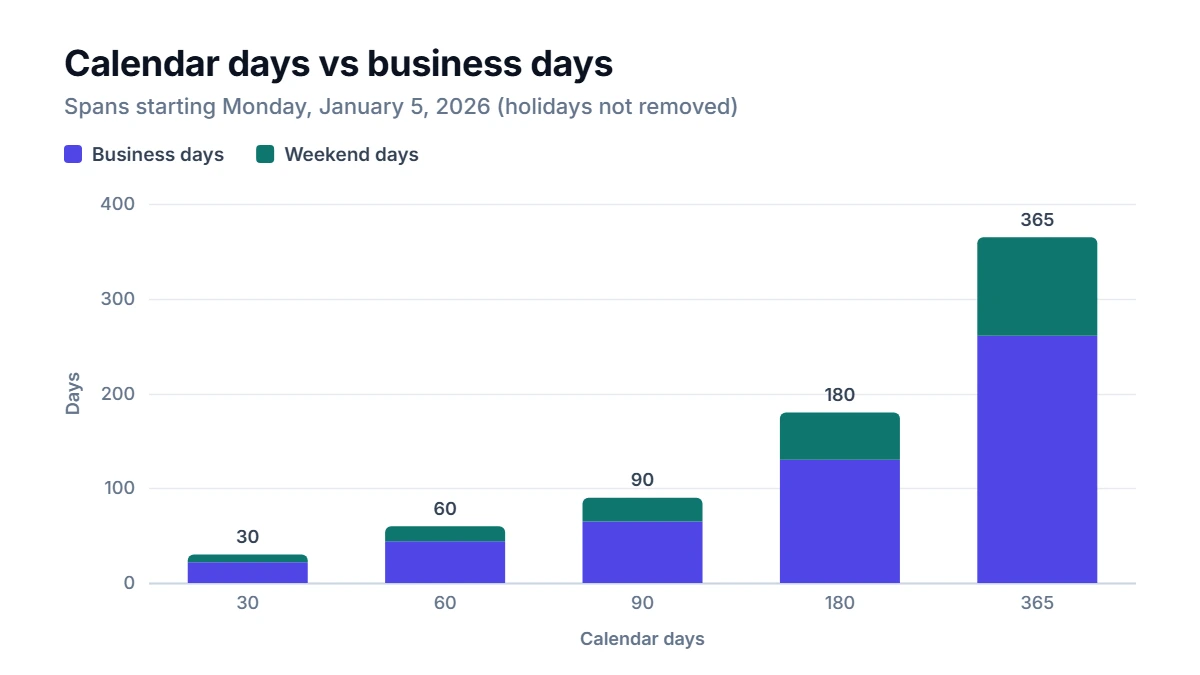
- 30 calendar days hold 22 business days.
- 90 calendar days hold 65 business days.
- 365 calendar days hold 261 business days.
Roughly, business days are about five sevenths of calendar days, but the exact figure depends on which weekday the range starts on. Public holidays reduce it further, and they vary by country and employer, so subtract the ones that apply to you.
Expressing the result in other units
A raw day count is not always the clearest way to say how long something is. The same 140 days from March 15 to August 2 can be written as:
- 20 weeks exactly, since 140 ÷ 7 = 20 with nothing left over.
- 4 months and 18 days, counting full months first (March 15 to July 15) and then the remaining days.
Months are the tricky unit, because "one month" can be 28, 29, 30 or 31 days. That is why a span such as "3 months" is not a fixed number of days, and why days or weeks are clearer for precise planning.
Using the Days Between Dates calculator
The Days Between Dates calculator does the counting for you. Choose a start date and an end date and press Calculate. The start date is set to today when the page opens, so for "how many days until" questions you only pick the end date. You can tick an option to include the end date, and another to see the Monday-to-Friday business day count as well. The result is also shown as weeks and days and as years, months and days. Leap years are handled automatically, and if the end date comes first, the dates are simply swapped.
A fun test: from May 20, 1990 to November 12, 2026 is 13,325 days, or 36 years, 5 months and 23 days. Try your own birthday.
Common mistakes
- Mixing elapsed and inclusive counts. Decide which one you need before you count, and write it down.
- Assuming every month has 30 days. Over half a year this can put you off by two or three days.
- Forgetting February 29. It only matters when the range contains it, but then it always matters.
- Counting business days without checking holidays. A "10 business day" deadline over a holiday week ends later than you think.
- Using time zones for dates. Day counts compare calendar dates, so a time zone or daylight saving change has no effect on them.
FAQ
How many days are in a year on average?
A common year has 365 days and a leap year 366. Over a long period the calendar averages 365.2425 days per year, because three out of every four century years skip the leap day.
How do I find the date 90 days from today?
That is the reverse problem: adding days to a date rather than counting between two. Adding or subtracting a fixed number of days needs a date-adding tool, or you can count forward month by month using the method above.
Why do two websites give me different answers?
One of them is probably counting inclusively and the other is not, which makes a difference of exactly one day. A few tools also count business days or ignore leap years, so check the settings.
How many weeks are between two dates?
Divide the day count by 7. The whole number is full weeks and the remainder is extra days. For example, 50 days is 7 weeks and 1 day.

