How to Find the Day of the Week for Any Date
With a handful of easy-to-remember dates and a little arithmetic, you can work out the weekday of any date in your head. Learn the Doomsday method step by step, with worked examples from 1776 to 2030.

What day of the week was July 4, 1776? What day will Christmas fall on in 2030? A calculator answers instantly, but there is also a method you can learn in an afternoon and use in your head for any date. It is called the Doomsday method, popularized by the mathematician John Conway, and it rests on one neat fact about the calendar.
The key idea: memory dates
In every year, a set of easy dates all fall on the same weekday. That weekday is called the year's doomsday. The memory dates are:
- 4/4, 6/6, 8/8, 10/10 and 12/12: the even months, day equals month
- 5/9 and 9/5, 7/11 and 11/7: a handy phrase is "working 9 to 5 at the 7-11"
- March 14 (Pi Day), and the last day of February
- January 3 in common years, January 4 in leap years
In 2026, the doomsday is Saturday. So April 4, June 6, October 10, December 12 and February 28, 2026 are all Saturdays. Once you know a year's doomsday, any date is only a short count away from one of these anchors.
Step 1: the century anchor
Each century has an anchor weekday that repeats in a 400-year cycle:
- 1600s: Tuesday
- 1700s: Sunday
- 1800s: Friday
- 1900s: Wednesday
- 2000s: Tuesday
- 2100s: Sunday
Step 2: the year's doomsday
Take the last two digits of the year, call them y, and compute three numbers:
- a = how many times 12 fits into y
- b = the remainder after that
- c = how many times 4 fits into b
Add a + b + c, divide by 7 and keep the remainder. Count that many days forward from the century anchor.
For 2026: y = 26, so a = 2, b = 2 and c = 0. The total is 4. Tuesday plus 4 days is Saturday, matching what we saw above.
Step 3: count from the nearest memory date
Find the memory date in the same month and count forward or back. Moving by 7 days keeps the weekday, so you only need to count the leftover days.
Worked examples
July 20, 1969 (the first Moon landing). The 1900s anchor is Wednesday. y = 69: a = 5, b = 9, c = 2, total 16, remainder 2. Wednesday plus 2 is Friday, so the 1969 doomsday is Friday. July 11 is a memory date, so July 18 is also a Friday, and July 20 is two days later: Sunday.
July 4, 1776. The 1700s anchor is Sunday. y = 76: a = 6, b = 4, c = 1, total 11, remainder 4. Sunday plus 4 is Thursday. July 11 is a Thursday, so July 4, one week earlier, is also a Thursday.
December 25, 2030. The 2000s anchor is Tuesday. y = 30: a = 2, b = 6, c = 1, total 9, remainder 2. Tuesday plus 2 is Thursday. December 12 is a Thursday, so December 26 is too, and Christmas Day is the day before: Wednesday.
November 24, 2026. The 2026 doomsday is Saturday, and November 7 is a memory date. November 21 is two weeks later, still a Saturday, and November 24 is three days after that: Tuesday.
Each of these results matches the Day of the Week Calculator.
Watch out for January and February
The leap day sits at the end of February, so January and February need care. In leap years, the memory dates are January 4 and February 29 instead of January 3 and February 28. Also remember the century rule: 2000 was a leap year, while 1900 and 2100 are not, because century years must be divisible by 400 to count.
A surprising result: Friday the 13th
Since the Gregorian calendar repeats exactly every 400 years, you can count how often the 13th of a month lands on each weekday over a full cycle. There are 4,800 thirteenths in 400 years, and they are not evenly spread:
- Friday: 688
- Sunday and Wednesday: 687 each
- Monday and Tuesday: 685 each
- Thursday and Saturday: 684 each
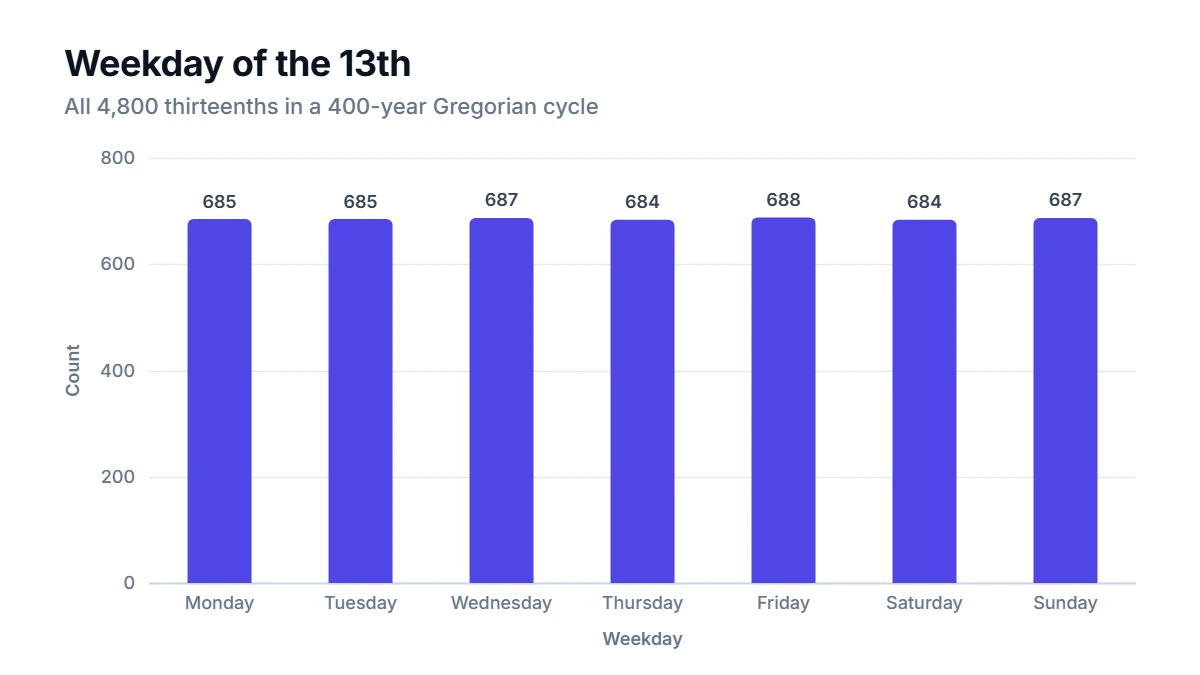
The differences are tiny, but Friday really is the most common weekday for the 13th. The reason is that a 400-year cycle is exactly 20,871 weeks long, so the same pattern repeats every cycle instead of evening out over time, and the leap-year rules happen to favor Friday by a hair.
How to use the calculator
Pick any date from the year 1 to 9999 in the Day of the Week Calculator and press Find the day. Alongside the weekday you also see the day of the year, the days left in the year, the quarter, whether the year is a leap year and the ISO week number. It is a quick way to check your mental arithmetic while you practice the method.
Good to know
- Historical dates and calendars. The Doomsday method and the calculator both use the Gregorian calendar extended backward. Many places used the Julian calendar until 1582 or much later, so a date written in an old document may refer to a different day than the modern calendar suggests.
- Practice the year step. It is the only part with real arithmetic. Some people memorize the doomsday for the current and next year and only calculate further out.
- Count in weeks. Adding or removing 7, 14 or 21 days never changes the weekday, so jump in weeks first and only count the rest.
FAQ
Why is it called the Doomsday method?
The name refers to the shared weekday of the memory dates in a given year, which Conway called the doomsday. It has nothing to do with disasters; it is simply a memorable label.
How long does it take to learn?
Most people can use it with a little paper help after one practice session. With a few weeks of regular practice, many can do it entirely in their head in well under a minute.
Does the method work for dates before 1600?
The arithmetic works for any year in the Gregorian calendar as extended backward, using the 400-year repeat of the century anchors. For historical dates, first check which calendar was used at the time and place.
Which weekday does a year's doomsday move to next year?
It moves forward by one day when the new year is a common year and by two days when the new year is a leap year. The 2026 doomsday is Saturday, so 2027's is Sunday, and 2028, a leap year, jumps to Tuesday.

