How to Find Your Target Heart Rate for Exercise
Your target heart rate tells you whether a workout is easy, moderate or hard. Learn how maximum heart rate is estimated, how the Karvonen method uses your resting pulse and how to use training zones.

Heart rate is one of the simplest ways to measure how hard you are working. A brisk walk might put you at 110 beats per minute, an easy jog at 135 and a hard sprint near your maximum. Training at the right intensity helps you build endurance without overdoing it, and it makes progress easier to track. This guide explains how target heart rates are estimated, why your resting pulse matters, and how to put the numbers to use.
Step 1: Estimate your maximum heart rate
Every target range is a percentage of your maximum heart rate, the fastest your heart can beat during all-out effort. Measuring it requires a hard, supervised exercise test, so most people use an age-based formula instead:
- 220 − age: the classic, easy to remember.
- Tanaka: 208 − 0.7 × age.
- Gellish: 207 − 0.7 × age.
For younger adults the classic formula gives the highest number. Around age 40 all three meet, and for older adults the two newer formulas give higher estimates.
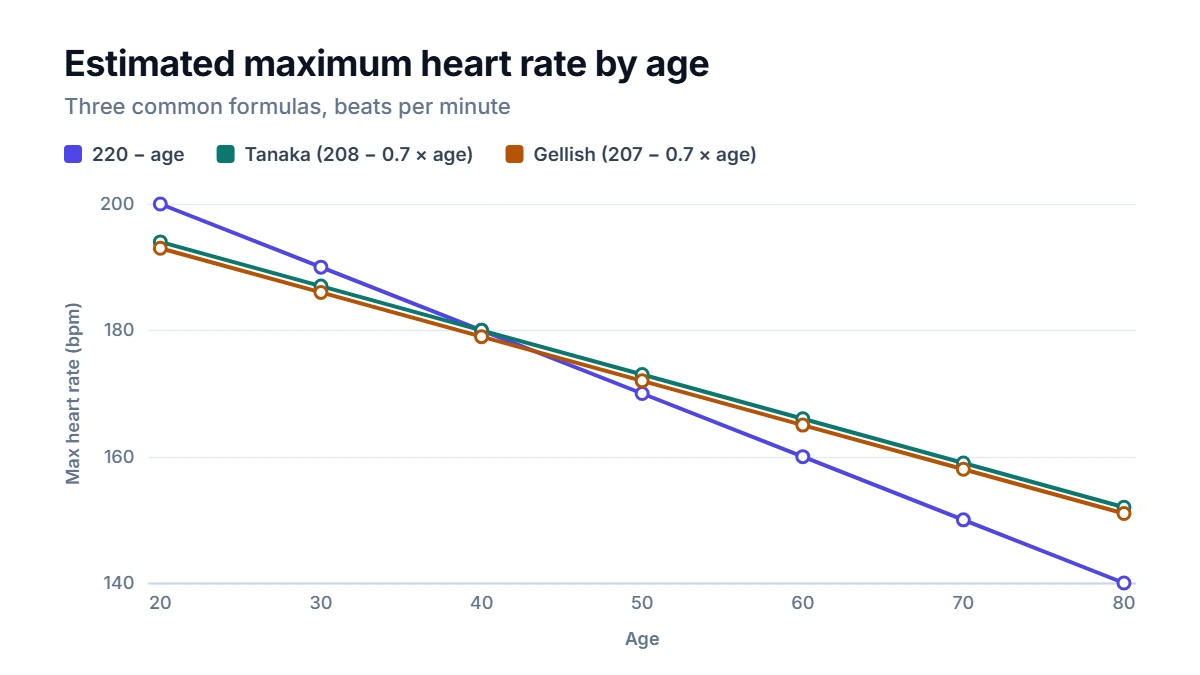
At age 20 the estimates are 200, 194 and 193 bpm; at 80 they are 140, 152 and 151 bpm. Treat all of them as averages: an individual's true maximum can be 10 bpm or more above or below the formula.
Step 2: Choose a method
Percentage of maximum
The simplest method multiplies the maximum by an intensity percentage:
target = intensity × maximum heart rate
General guidelines describe moderate exercise as about 50–70% of maximum and vigorous exercise as about 70–85%.
The Karvonen method
The Karvonen method also uses your resting heart rate. The gap between resting and maximum is called your heart rate reserve, and the percentage is applied to that reserve:
target = resting + intensity × (maximum − resting)
Because a fitter person usually has a lower resting rate and a wider reserve, this method tends to fit individual fitness better, and it gives noticeably higher numbers at the easy end of the scale.
A worked example
Take a 45-year-old with a resting heart rate of 65 bpm, using 220 − age.
- Maximum heart rate: 220 − 45 = 175 bpm.
- Heart rate reserve: 175 − 65 = 110 bpm.
- Moderate range (50–70%): 65 + 0.50 × 110 = 120 bpm to 65 + 0.70 × 110 = 142 bpm.
- Vigorous range (70–85%): 142 bpm to 65 + 0.85 × 110 ≈ 159 bpm.
With the percentage method and no resting rate, the same person gets 88–122 bpm for moderate and 122–149 bpm for vigorous exercise. The Karvonen ranges start about 30 bpm higher because they build on the resting rate rather than on zero.
Switching formulas changes the picture only a little at this age: Tanaka gives a maximum of 177 bpm and Gellish 176 bpm.
Training zones
Many coaches split the range into five zones. For our 45-year-old using the Karvonen method:
- Zone 1, 50–60%: 120–131 bpm. Warm-ups, cool-downs, recovery days.
- Zone 2, 60–70%: 131–142 bpm. Easy, conversational endurance work that builds your aerobic base.
- Zone 3, 70–80%: 142–153 bpm. Steady aerobic training that improves heart and lung fitness.
- Zone 4, 80–90%: 153–164 bpm. Tempo and threshold efforts; you can speak only in short phrases.
- Zone 5, 90–100%: 164–175 bpm. Short intervals and sprints that last seconds to a few minutes.
A common approach for general fitness and endurance is to spend most of your training time in zones 1 and 2, with smaller amounts of harder work. Beginners usually start near the bottom of the moderate range and build up over weeks.
How to use the Target Heart Rate Calculator
Enter your age and, if you know it, your resting heart rate. Choose one of the three maximum heart rate formulas and press Calculate. The Target Heart Rate Calculator shows your estimated maximum, your moderate and vigorous ranges and which method was used: Karvonen when you enter a resting rate, a plain percentage when you do not. A table lists all five zones with their heart rate ranges and what each is used for.
Measuring your heart rate
- Resting rate: count your pulse for a full minute right after waking, before you get out of bed, on three or four mornings, and use the average.
- During exercise: a chest strap is the most accurate. Wrist-based watches are convenient but can lag behind fast changes or slip during intervals.
- By hand: stop, find the pulse at your wrist or neck, count for 15 seconds and multiply by 4. Your heart rate drops quickly once you stop, so count straight away.
Good to know
- Use the talk test too. At moderate intensity you can talk but not sing; at vigorous intensity you can say only a few words. If the numbers and the talk test disagree, trust how you feel.
- Heart rate drifts. On long or hot workouts your heart rate slowly rises even at the same pace. Heat, dehydration, caffeine, stress and poor sleep all push it up.
- Medication matters. Some medicines, such as beta blockers, lower heart rate, and then these ranges may not apply.
- These are estimates, not medical advice. Talk to a doctor before starting vigorous exercise, especially if you have a heart condition or have been inactive, and stop if you feel chest pain, dizziness or unusual breathlessness.
FAQ
Which formula is the most accurate?
None is exact for an individual. The Tanaka and Gellish formulas were built from larger and more varied groups, so many people prefer them over 40. The most important thing is to pick one and use it consistently so your zones stay comparable over time.
Why is my heart rate higher than the target at an easy pace?
Your true maximum may be higher than the estimate, or heat, fatigue or caffeine may be raising it on that day. It also takes time for fitness to improve. If an easy effort feels easy, a few beats above the range is usually not a concern.
Does a lower resting heart rate mean I am fitter?
Often, yes. Regular endurance training makes the heart pump more blood with each beat, so it needs fewer beats at rest. A resting rate that suddenly rises by several beats can be a sign of illness, poor sleep or overtraining.
How often should I recalculate my zones?
Recalculate when your resting heart rate changes by a few beats, after a few months of regular training, or once a year as your age changes.

