How World Time Zones Work
Why is India 5 hours 30 minutes ahead of London, and why does the gap to Sydney change in July? A clear guide to UTC, time zones, daylight saving and the date line.

When it is breakfast time in London, people in Los Angeles are still asleep and offices in Tokyo are closing for the day. Time zones are the system that keeps every local clock roughly in step with the sun while letting the whole world agree on a single moment. Knowing how they are built, and where the odd exceptions are, makes a world clock far easier to read and helps you plan calls, travel and deadlines.
Why we have time zones at all
For most of history, every town kept its own local time based on the sun: noon was when the sun was highest. That worked until railways and telegraphs connected distant cities, and timetables became a mess of slightly different local times. In the late 1800s, railway companies and then governments adopted standard time zones, and an international conference in 1884 chose the meridian through Greenwich, near London, as the reference line for longitude.
The Earth turns 360° in 24 hours, or 15° per hour, so in theory the world splits into 24 zones each one hour wide. In practice, zone borders follow countries and regions rather than straight lines, which is where most of the surprises come from.
UTC: the clock everyone compares against
Today every zone is defined by its offset from Coordinated Universal Time (UTC), an atomic time standard that does not change with the seasons. Tokyo is UTC+9, meaning its clocks are nine hours ahead of UTC. New York in winter is UTC−5, five hours behind. A world clock is really a list of offsets applied to the same UTC moment.
Offsets that are not whole hours
Not every zone sits on the hour. A few well-known examples:
- India uses UTC+5:30 for the whole country.
- Nepal uses UTC+5:45.
- Parts of Australia, such as Adelaide and Darwin, use half-hour offsets.
- Newfoundland in Canada uses UTC−3:30 in winter.
When a city is a half or quarter hour off from yours, the difference shown on a world clock will include minutes, such as +4 h 30 min.
One zone for a huge country, many zones for a small one
Zone borders are political choices. China spans roughly the width of five standard zones, yet the whole of mainland China uses Beijing time, UTC+8. In the far west of the country, that means the sun can rise very late in the morning by the clock. Other countries go the other way: the United States uses several zones on its mainland alone, and Russia spans eleven.
Daylight saving time moves the picture twice a year
Many countries move their clocks forward one hour in summer and back in winter. Because this is decided locally, the offsets between cities change during the year. Countries near the equator, such as Singapore, and many countries in Asia and Africa, do not use daylight saving at all. In the southern hemisphere, summer falls in December and January, so places like Sydney and Auckland move their clocks forward when the north moves them back.
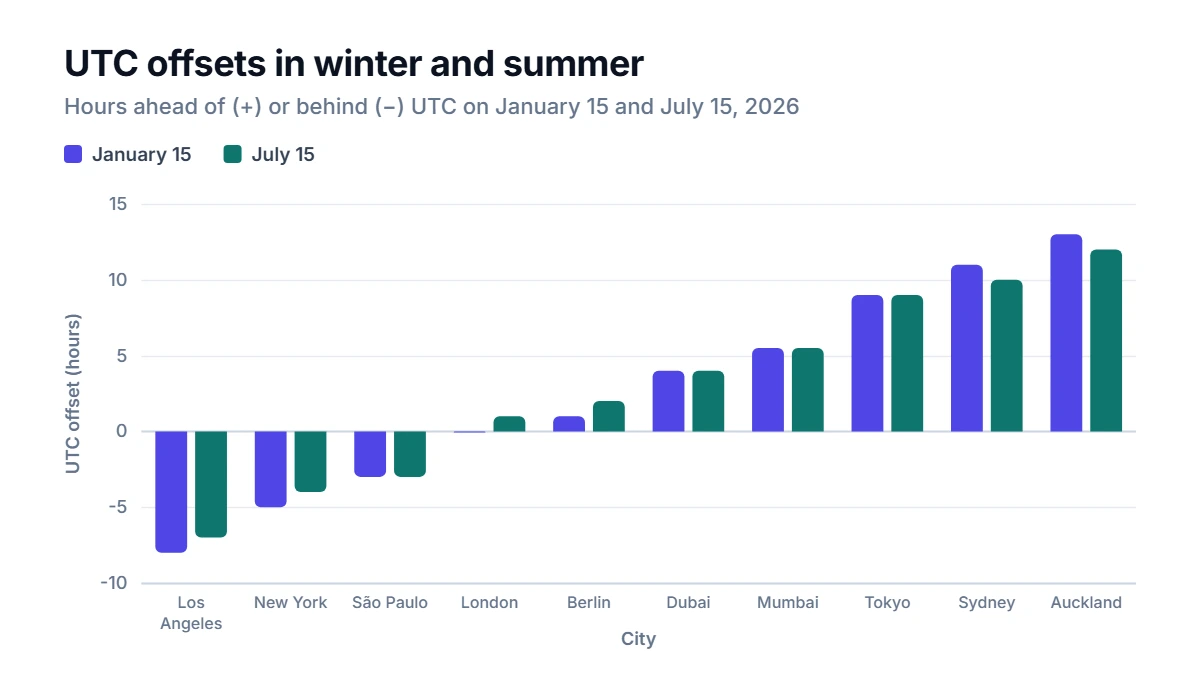
The chart shows the effect clearly. Los Angeles, New York, London and Berlin are one hour further east in July. Sydney and Auckland are one hour further east in January. São Paulo, Dubai, Mumbai and Tokyo do not change. As a result, the gap between London and Sydney is 11 hours in January but only 9 hours in July.
A worked example: one moment around the world
Say it is 9:00 AM in London on Wednesday, July 15, 2026. London is on summer time, UTC+1, so the moment is 08:00 UTC. The World Clock shows:
- Los Angeles (UTC−7): 1:00 AM, 8 hours behind London
- New York (UTC−4): 4:00 AM, 5 hours behind
- São Paulo (UTC−3): 5:00 AM, 4 hours behind
- Berlin (UTC+2): 10:00 AM, 1 hour ahead
- Dubai (UTC+4): 12:00 PM, 3 hours ahead
- Mumbai (UTC+5:30): 1:30 PM, 4 hours 30 minutes ahead
- Tokyo (UTC+9): 5:00 PM, 8 hours ahead
- Sydney (UTC+10): 6:00 PM, 9 hours ahead
- Auckland (UTC+12): 8:00 PM, 11 hours ahead
Everyone is on the same Wednesday at this moment, but only just. Four hours later, at 12:00 UTC, it is midnight in Auckland and already Thursday, while New York has only reached 8:00 AM on Wednesday.
The International Date Line
Somewhere the calendar has to change. The International Date Line runs roughly along the 180° meridian through the Pacific Ocean, with zigzags around island nations. Cross it heading west and the date jumps forward a day; cross it heading east and you repeat a day. This is why Auckland, 19 hours ahead of Los Angeles in July, is on the next calendar date for most of the day, and why a flight from Asia to North America can arrive "before" it left.
Reading a world clock quickly
- Look at the offset, not just the time. The difference from your own time tells you instantly whether someone is starting or ending their day.
- Check the date line. A card marked as tomorrow or yesterday is a warning when you set deadlines.
- Watch the night shading. On the analog faces of the World Clock, a dark face means it is between 6 PM and 6 AM in that city, a quick signal not to call.
- Remember the season. If you learned a time difference in winter, it may be an hour off in summer.
FAQ
How many time zones are there?
In theory 24, one for each hour. In practice there are more than 35 different offsets in use, because of half-hour and quarter-hour zones and offsets beyond 12 hours, such as UTC+13 and UTC+14 in the Pacific. The time zone database used by computers lists hundreds of regions, because it also tracks historical changes.
Why does China use only one time zone?
It is a national policy choice that keeps the whole country on the same official clock, Beijing time. The trade-off is that in western regions local daily life often runs later by the clock to match daylight.
What is the International Date Line?
It is the line in the Pacific where the calendar date changes. Places just west of it, such as New Zealand, are among the first to start each new day, while places just east of it are among the last.
Why is the time difference to Sydney different in July?
Sydney is in the southern hemisphere, so it uses daylight saving time from about October to April. Most northern countries use it from about March to October. When both are on standard time, or one is on summer time and the other is not, the gap between them changes by an hour or two.
