How to Compare Unit Prices and Find the Best Deal
The biggest package is not always the cheapest. Learn how to work out the price per ounce, liter or item, compare packages in different units and spot shrinkflation on the shelf.

Two bags of coffee sit side by side: one is cheaper, the other is bigger. Which is the better buy? The only fair way to answer is the unit price, the cost of one ounce, one liter or one item. This guide shows how to work it out when packages use different units, why the biggest package is not always the cheapest, and the traps that shelf labels and family-size packs can set.
What unit price means
Unit price = price ÷ quantity. A 2 l bottle for 5.49 costs 5.49 ÷ 2 = 2.745 per liter. On its own the number says little; its power is in comparison. Once every option is expressed per the same unit, the cheapest one is simply the lowest number.
The catch is the phrase "the same unit". Before you divide, every quantity has to be converted to one common unit.
Converting to a common unit
The conversions you need most in a store:
- 1 lb = 16 oz, and 1 oz ≈ 28.35 g.
- 1 kg = 1,000 g ≈ 35.27 oz.
- 1 US fl oz ≈ 29.57 ml, and 1 l = 1,000 ml ≈ 33.81 fl oz.
- Weight ounces (oz) and fluid ounces (fl oz) are different units. One measures weight, the other volume, and they cannot be compared directly.
Pick whichever unit is convenient, convert everything to it, then divide.
A worked example: four bags of coffee
Here are four options for ground coffee:
- A 12 oz bag for 8.99
- A 2 lb bag for 19.49
- A 1 kg bag for 21.99
- A 340 g bag on sale for 6.49
Convert to ounces and divide:
- 8.99 ÷ 12 = 0.7492 per oz
- 2 lb = 32 oz, so 19.49 ÷ 32 = 0.6091 per oz
- 1 kg ≈ 35.27 oz, so 21.99 ÷ 35.27 = 0.6234 per oz
- 340 g ≈ 11.99 oz, so 6.49 ÷ 11.99 = 0.5411 per oz
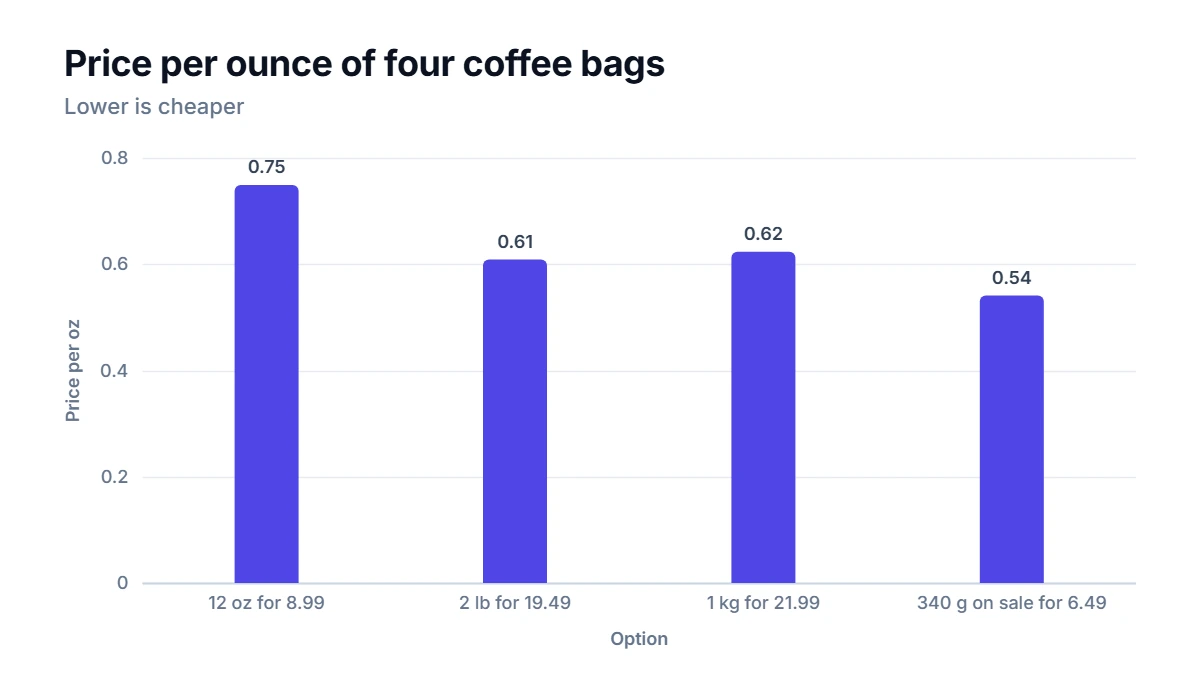
The small bag on sale wins. It is 11.2% cheaper per ounce than the 2 lb bag, the next best option, and the regular 12 oz bag costs 38.4% more per ounce than the sale bag. Notice too that the 1 kg bag, the largest of the four, is not the cheapest: the 2 lb bag beats it slightly.
Bigger is not always cheaper
"Buy the biggest pack" is a good rule of thumb that fails often enough to be worth checking. Three common cases:
- Sales on regular sizes. As in the coffee example, a promotion on a smaller size can beat the bulk size.
- Count-based products. A 64-load bottle of detergent for 13.99 costs about 0.219 per load, while a 110-load bottle for 24.99 costs about 0.227 per load. The bigger bottle is 3.9% more expensive per wash.
- Multipacks. A 6-pack of 355 ml cans for 4.99 works out to about 2.34 per liter, while a 2 l bottle for 5.49 is 2.75 per liter. Here the multipack wins, but that is not guaranteed, so check each time.
Spotting shrinkflation
Sometimes the price stays the same and the package gets smaller. If a 16 oz bag that cost 4.29 becomes a 14.5 oz bag at the same 4.29, the unit price rises from 0.2681 to 0.2959 per oz. That is a 10.3% price increase you will only notice through the unit price, because the shelf price did not move.
Keep a note of the unit prices you usually pay for staples. It makes both shrinkflation and genuinely good deals easy to recognize.
Reading the shelf label
Many stores print a unit price on the shelf tag, which saves you the math. Two things to watch:
- Different units for similar products. One tag may show the price per ounce and the one next to it per pound, or per 100 g against per kg. Convert before you compare.
- Per item versus per weight. Fruit and vegetables can be priced per item or by weight. A bag of 6 apples needs weighing, or at least an estimate, before you can compare it with loose apples sold by the pound.
How to use the Unit Price Calculator
Enter the price, quantity and unit for each product, up to six options. Units of the same kind are converted automatically, so you can put a 12 oz bag next to a 1 kg bag. Press Compare and the Unit Price Calculator names the cheapest option, shows how much cheaper it is than the next best and lists the price per unit of each, with a table of how much more every other option costs. Weight, volume and count cannot be mixed, because there is no honest way to turn a liter into a number of items.
When the lowest unit price is not the best buy
- Waste. A large tub that spoils before you finish it costs more than a small one you use up. The price per unit you actually use is what counts.
- Storage and cash flow. Bulk buying ties up money and cupboard space, which may not be worth a few cents per ounce.
- Concentration. A concentrated detergent may need less per load, so compare by loads or uses where the label gives them, not by volume.
- Membership or delivery costs. If you pay extra to shop at a bulk store or to have goods delivered, add that to the price before comparing.
FAQ
How do I compare a price per pound with a price per kilogram?
Convert one into the other. A kilogram is about 2.2046 pounds, so dividing a price per kg by 2.2046 gives the price per pound. 9.00 per kg is about 4.08 per lb.
Is unit pricing useful for things other than groceries?
Yes. It works for anything sold in quantities: printer paper per sheet, batteries per cell, mobile data per gigabyte, paint per liter, even a streaming service per hour you actually watch.
How many decimal places should I keep?
At least three or four. Unit prices are often fractions of a cent, and rounding 0.2181 and 0.2149 both to 0.22 would hide a real difference. Round only the final answer.


