How to Convert Length Units: Metric and Imperial
Every conversion between inches, feet, miles and meters rests on one exact number. Learn the method, work through heights, rooms and race distances, and pick up mental shortcuts that are close enough.

Most of the world measures length in meters, while the United States still uses inches, feet, yards and miles in daily life. That means plenty of everyday conversions: a height on a form, the size of a room, a race distance, a screw in a parts list. The good news is that every one of these conversions rests on a single exact number, and once you know it, the rest follows.
Two systems, one exact link
The metric system is built on the meter and powers of ten: 1 kilometer is 1,000 meters, 1 meter is 100 centimeters, and 1 centimeter is 10 millimeters. Moving between metric units only means moving the decimal point.
The US customary (imperial) system grew out of older trade measures, so its steps are uneven: 12 inches make a foot, 3 feet make a yard, and 1,760 yards (5,280 feet) make a mile.
The two systems are joined by one definition agreed in 1959: 1 inch = 2.54 centimeters, exactly. From that, every other link is exact too:
- 1 foot = 12 × 2.54 = 30.48 cm = 0.3048 m
- 1 yard = 3 × 0.3048 = 0.9144 m
- 1 mile = 5,280 × 0.3048 = 1,609.344 m
Going the other way gives the familiar but not-quite-round factors: 1 meter ≈ 3.2808 feet, 1 kilometer ≈ 0.6214 miles, 1 millimeter ≈ 0.03937 inches.
How to convert any length by hand
The safest method is to go through a base unit, usually the meter:
- Multiply your value by the size of the starting unit in meters.
- Divide by the size of the target unit in meters.
For 300 feet to meters: 300 × 0.3048 = 91.44 m. For 10 miles to kilometers: 10 × 1,609.344 = 16,093.44 m, and 16,093.44 ÷ 1,000 = 16.09344 km.
The advantage of going through meters is that you never need a table of every unit pair. Nine units would need 72 direct factors; with a base unit you need just nine.
Worked examples from everyday life
Height: feet and inches to centimeters
A height of 5 ft 10 in is first turned into inches only: 5 × 12 + 10 = 70 in. Then 70 × 2.54 = 177.8 cm.
Height: centimeters to feet and inches
This is the one people get wrong most often. Take 180 cm:
- 180 ÷ 2.54 = 70.866 inches.
- 70.866 ÷ 12 = 5 whole feet, with 70.866 − 60 = 10.866 inches left over.
- So 180 cm is about 5 ft 10.9 in.
The common mistake is to write 180 cm as 5.91 ft and read it as "5 foot 9". But 5.91 ft means 5 feet plus 0.91 of a foot, which is about 10.9 inches, not 9 inches.
A room: meters to feet
A room 3.5 m long is 3.5 ÷ 0.3048 ≈ 11.48 ft. To get feet and inches, multiply the decimal part by 12: 0.48 × 12 ≈ 5.8, so about 11 ft 5.8 in.
Sports and running
A 100 m sprint is about 109.36 yards, slightly longer than an American football field between the goal lines. A standard 400 m track lap is about 0.2485 miles, so four laps are just under a mile.
Running race distances are set in kilometers, but many runners think in miles:
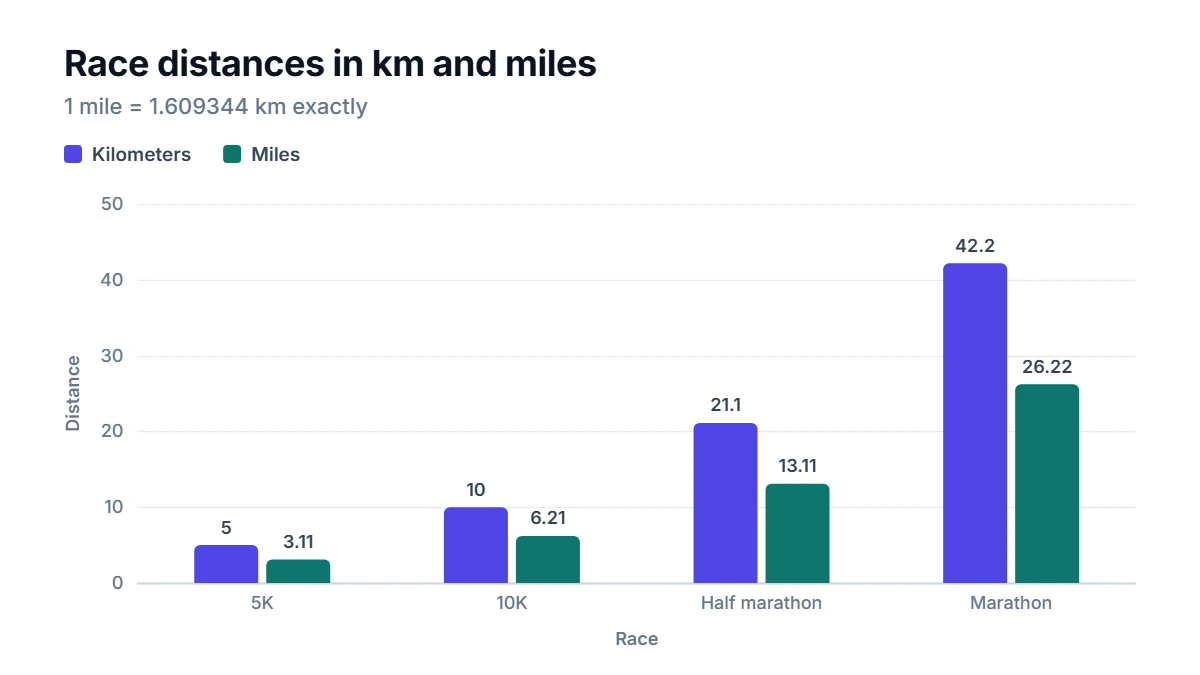
- 5K = 3.11 mi
- 10K = 6.21 mi
- Half marathon (21.0975 km) = 13.11 mi
- Marathon (42.195 km) = 26.22 mi
At sea and in the air
A nautical mile is 1,852 m by definition, about 1.1508 ordinary miles. It is used for navigation because one nautical mile corresponds closely to one minute of latitude, which makes distances easy to read off a chart. Speeds in knots are nautical miles per hour.
Quick mental shortcuts
When you just need a rough idea, these are close enough:
- Inches to centimeters: multiply by 2.5 (true value 2.54).
- Feet to meters: multiply by 0.3, or divide by 3.3.
- Meters to feet: multiply by 3.3 (true value about 3.28).
- Miles to kilometers: multiply by 1.6.
- Kilometers to miles: multiply by 0.6, or by 5 and divide by 8.
The 5/8 trick is surprisingly good: 40 km × 5 ÷ 8 = 25 mi, while the exact answer is 24.85 mi. For building, sewing, engineering or anything you will cut or order, use the exact factors instead.
Using the Length Converter
The Length Converter handles nine units: millimeters, centimeters, meters, kilometers, inches, feet, yards, miles and nautical miles. Type the value, pick the starting unit and the target unit, and press Convert. A table below the answer lists the same length in every unit at once, which is handy when you are not sure which unit a form or a product page expects. The swap button reverses the direction so you can check a result backwards.
For mixed units such as 5 ft 10 in, convert to a single unit first (70 in) or use a dedicated height converter.
Common mistakes
- Treating decimal feet as inches. 5.5 ft is 5 ft 6 in, not 5 ft 5 in.
- Rounding too early. Using 0.3 instead of 0.3048 for feet to meters is a 1.6% error. Over 300 ft that is almost 1.5 m.
- Mixing up the two miles. Nautical miles are about 15% longer than statute miles; marine and aviation figures almost always mean nautical miles.
- Area and volume are different. A square foot is not 0.3048 square meters. Area factors are squared (1 ft² ≈ 0.0929 m²), so use an area converter for floor space.
FAQ
Why does the US still use inches and feet?
Customary units are built into American building codes, tools, road signs and everyday habits, and switching would be costly. Science, medicine and most manufacturing in the US already work in metric.
Is a UK mile the same as a US mile?
Yes. Since the international yard and pound agreement of 1959, the inch, foot, yard and mile are the same in the US, the UK and other countries that use them.
How precise are the results?
The factors between units are exact, so the only rounding happens when the result is displayed. The converter shows up to six decimal places, which is far more precision than a tape measure can give.
What is the easiest way to read a metric ruler?
Each numbered mark is a centimeter and each small mark between them is a millimeter. A reading of 4 numbered marks plus 7 small marks is 4.7 cm, or 47 mm.

