How to Calculate Forex Position Size From Your Risk
A step-by-step method for sizing forex trades from your risk and stop loss, with worked examples for GBP/USD and a cross pair, and why consistent risk matters.

Most traders spend their energy on where to enter a trade. Experienced ones spend just as much on how big the trade should be. Position size decides how much a losing trade costs you, and getting it right is the difference between a bad week and a wiped-out account. The good news is that the calculation is mechanical: once you choose your risk and your stop loss, the lot size follows.
Start with risk, not with lots
Many beginners pick a lot size first, often whatever feels "normal", and then place a stop wherever it happens to fit. That reverses the logic. A sound process runs the other way:
- Decide how much of your account you are willing to lose if this trade fails.
- Place your stop loss where the trade idea is clearly wrong, based on the chart, not on the money.
- Calculate the position size that makes the loss at that stop equal to your chosen risk.
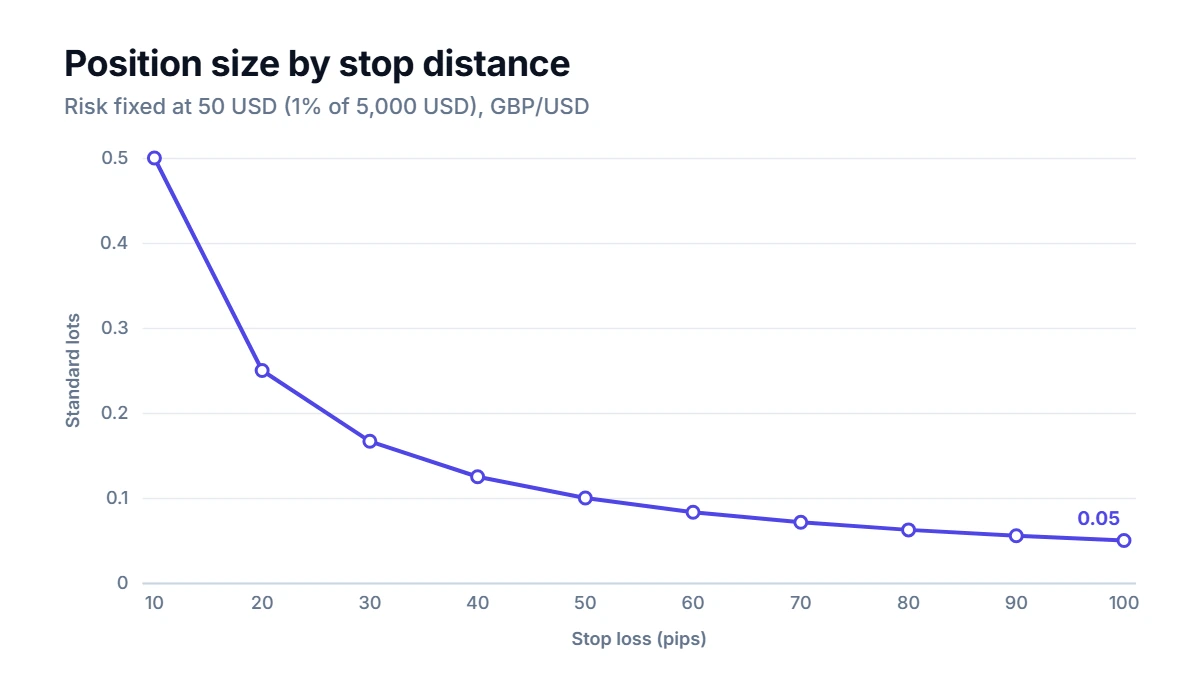
With this approach, every trade risks the same amount of money, whether the stop is 15 pips or 150 pips away. A wide stop simply means a smaller position.
The building blocks
- Pip: the standard price step. For most pairs it is 0.0001; for pairs quoted in Japanese yen it is 0.01.
- Lot: a standard lot is 100,000 units of the base currency, a mini lot 10,000 and a micro lot 1,000. Many brokers allow steps of 0.01 lots.
- Pip value: how much money one pip is worth for your position. For pairs quoted in your account currency, such as EUR/USD or GBP/USD on a USD account, one pip on one standard lot is worth 10 USD.
The formula
- Risk amount = account balance × risk percentage.
- Loss per unit at the stop = stop distance in pips × pip value of one unit.
- Position size in units = risk amount ÷ loss per unit.
- Lots = units ÷ 100,000.
Worked example: GBP/USD
You have a 5,000 USD account and decide to risk 1% per trade. You want to buy GBP/USD with a stop 35 pips below your entry.
- Risk amount: 5,000 × 1% = 50 USD.
- One unit of GBP/USD moves 0.0001 USD per pip, so the loss per unit at the stop is 35 × 0.0001 = 0.0035 USD.
- Position size: 50 ÷ 0.0035 = 14,285 units (rounded down).
- In lots: 0.14285 standard lots, or about 1.43 mini lots.
Your broker probably only accepts steps of 0.01 lots, so you round down to 0.14 lots. The loss at the stop is then 14,000 × 0.0035 = 49 USD, just under your plan. Rounding up to 0.15 would push the risk to 52.50 USD.
Now say the chart suggests a wider stop of 70 pips. The risk amount stays 50 USD, but the position halves to about 7,142 units, or 0.07 lots. The money at risk is the same; only the size changes.
Cross pairs need one exchange rate
When the pair's quote currency is not your account currency, the pip value has to be converted. Take EUR/GBP on the same USD account, with a 20-pip stop and 1% risk.
- The pip value of EUR/GBP is in GBP: 0.0001 GBP per unit per pip.
- To turn it into USD you need the GBP/USD rate. Suppose it is 1.25 at the moment you trade (always use the live price on your platform).
- Pip value per unit = 0.0001 × 1.25 = 0.000125 USD, which is 12.50 USD per pip for a standard lot.
- Position size: 50 ÷ (20 × 0.000125) = 20,000 units, exactly 0.2 lots.
Because exchange rates move, the pip value of cross pairs moves with them. Recalculate before each trade rather than reusing yesterday's number.
How to use the calculator
The Lot Size Calculator runs these steps for you. Choose your account currency, enter the balance and pick a risk mode: a percentage of the balance or a fixed amount. Enter your stop loss in pips and choose the pair from the list, or select Other to type your own base currency, quote currency and pip size. If a conversion is needed, the calculator tells you exactly which exchange rate to enter and never fetches prices on its own. The result shows units and standard, mini and micro lots, and the details card shows the size rounded down to 0.01, 0.1 and 1 lot steps with the actual risk for each.
Why consistent risk matters
Losing streaks happen to every trading approach. Fixed-percentage risk keeps a run of losses survivable. After ten losses in a row, a 5,000 USD account would be at about:
- 4,522 USD risking 1% per trade
- 4,085 USD risking 2% per trade
- 2,994 USD risking 5% per trade
At 5% risk, ten losses cost 40% of the account, and you would then need a gain of about 67% just to get back to where you started. Smaller risk per trade means smaller drawdowns and an easier recovery. How much to risk is a personal decision; these figures only show the arithmetic.
Common mistakes
- Moving the stop to fit a bigger position. The stop should come from the chart. Size the position to the stop, never the reverse.
- Using the wrong pip size. Yen pairs use 0.01. Many platforms also show a fifth decimal (a "pipette"), which is a tenth of a pip. A 50-point stop on such a platform may only be 5 pips.
- Ignoring costs. Spreads, commissions, swaps and slippage add to the real loss. On fast markets or around news releases, stops can fill at a worse price.
- Forgetting other open trades. Three positions in correlated pairs, each risking 1%, behave more like one trade risking up to 3%.
- Instruments that are not currency pairs. Gold, indices and crypto often have different contract sizes and pip definitions. Check your broker's contract specification and use the custom option.
The results are estimates and not investment advice. Trading with leverage can lose more than you expect; check your broker's rules and the current conditions before you trade.
FAQ
Should I round the lot size up or down?
Down. Rounding down keeps the loss at your stop at or below the amount you planned. Rounding up, even by one step, means risking a little more than you decided.
Does leverage change the position size?
No. Leverage changes how much margin your broker holds for a position, not how much you lose per pip. The position size from your risk and stop stays the same; leverage only decides whether your account has enough margin to open it.
What if the calculated size is smaller than my broker's minimum?
Then the trade, with that stop, would risk more than you planned even at the smallest size. You can skip the trade, look for a setup with a tighter logical stop, or accept a higher risk knowingly.
Do I need to recalculate for every trade?
Yes, if anything changed: balance, stop distance, the pair or the exchange rate for cross pairs. It takes seconds, and it keeps the risk on every trade consistent.
Related tools


Related guides

How to Calculate Pip Value in Forex
A pip is the small price step that forex moves are measured in, and its value decides how much each move costs or earns you. Learn the formula, see worked examples for USD, yen and cross pairs, and avoid common sizing mistakes.

How to Calculate the Risk-Reward Ratio of a Trade
The risk-reward ratio tells you how much a trade can make for every unit it can lose, and the win rate it needs to pay off. Here is how to calculate it, read it and avoid the usual traps.

What Is Dollar-Cost Averaging? How It Works, With Examples
Investing the same amount every month means you automatically buy more when prices are low. Learn how dollar-cost averaging works, why your average cost ends up below the average price, and when a lump sum would have done better.

How Long Will It Take to Pay Off Your Loan?
If you know what you can pay each month, you can work out exactly when a debt will be gone and what it will cost. See how the payoff time is calculated and why a slightly bigger payment shortens it so much.