How to Calculate Pip Value in Forex
A pip is the small price step that forex moves are measured in, and its value decides how much each move costs or earns you. Learn the formula, see worked examples for USD, yen and cross pairs, and avoid common sizing mistakes.

Forex traders rarely say "the euro rose by 0.0035 dollars". They say it rose 35 pips. A pip is a convenient unit for price moves, but on its own it says nothing about money. Thirty-five pips can mean a few cents on a tiny position or hundreds of dollars on a large one. Pip value is the bridge between the two, and it is the number you need before you can set a sensible stop loss or decide how big a position should be.
What a pip is
A pip is the conventional price step of a currency pair:
- 0.0001 for most pairs, such as EUR/USD, GBP/USD or AUD/USD. If EUR/USD moves from 1.0850 to 1.0851, it moved one pip.
- 0.01 for pairs quoted in Japanese yen, such as USD/JPY or EUR/JPY, because the yen's price per unit is much larger.
Most platforms show one more decimal place, the pipette or fractional pip, worth one tenth of a pip. A quote of 1.08505 has moved half a pip from 1.08500.
Lots and units
Position sizes are usually given in lots:
- a standard lot is 100,000 units of the base currency, the first currency in the pair
- a mini lot is 10,000 units
- a micro lot is 1,000 units
So 0.3 lots means 30,000 units, and 5 micro lots means 5,000 units.
The pip value formula
Pip value starts in the quote currency, the second currency of the pair:
Pip value (quote currency) = units × pip size
Then it is converted into your account currency:
- If your account is in the quote currency, you are done.
- If your account is in the base currency, divide by the pair's current price.
- Otherwise, convert with the exchange rate between the quote currency and your account currency.
Worked examples on a USD account
EUR/USD, one standard lot. 100,000 × 0.0001 = 10 USD per pip. The quote currency is already USD, so no conversion is needed. A 20-pip move is worth 200 USD.
GBP/USD, 0.3 lots, 25 pips. 30,000 × 0.0001 = 3 USD per pip, so 25 pips are worth 75 USD.
USD/JPY, one standard lot, price 150.00. 100,000 × 0.01 = 1,000 JPY per pip. The account is in USD, the base currency, so divide by the price: 1,000 ÷ 150 ≈ 6.67 USD per pip.
GBP/JPY, 3 mini lots, 40 pips, USD/JPY at 150.00. 30,000 × 0.01 = 300 JPY per pip. Converting with USD/JPY gives 300 ÷ 150 = 2 USD per pip, so 40 pips are worth 80 USD.
EUR/GBP, one standard lot, GBP/USD at 1.30. 100,000 × 0.0001 = 10 GBP per pip, and 10 × 1.30 = 13 USD per pip.
The exchange rates in these examples are illustrative; real prices change all the time.
Pip value is not the same for every pair
A common belief is that one pip on a standard lot is always worth 10 dollars. That is only true when the quote currency is USD. For other pairs it depends on the exchange rate, as the chart shows for a USD account at sample rates.
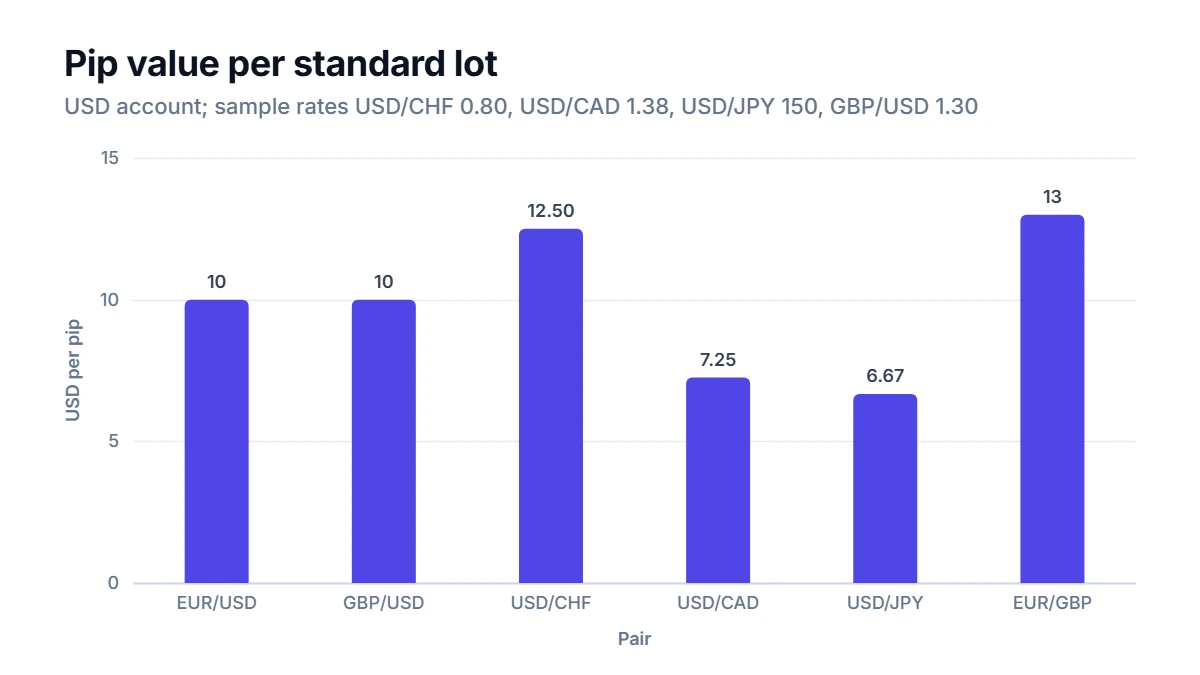
With USD/CHF at 0.80, a pip is worth 12.50 USD. With USD/CAD at 1.38, it is about 7.25 USD. If you trade several pairs with the same 30-pip stop, your risk in dollars on EUR/GBP is almost twice as large as on USD/CAD.
Accounts in other currencies
The same logic works for any account currency. On a EUR account, EUR/USD has the account currency as its base, so you divide: 10 USD per pip ÷ 1.08 ≈ 9.26 EUR per pip at a price of 1.08. As the euro strengthens, each pip is worth fewer euros, and as it weakens, more.
Using pip value to size a position
Pip value turns a stop loss in pips into money at risk:
Money at risk = pip value per lot × lots × stop loss in pips
Say you want to risk no more than 75 USD on a GBP/USD trade with a 25-pip stop. Each standard lot is worth 10 USD per pip, so one lot would risk 250 USD. Dividing 75 by 250 gives 0.3 lots, which matches the second example above. Many traders work the other way round: decide the risk first, then pick the position size that keeps the loss within it.
How to use the Pip Value Calculator
Choose your account currency, enter the position size in standard, mini or micro lots or in units, and enter the number of pips you care about, such as your stop or target distance. Pick the currency pair, or choose Other to set your own base currency, quote currency and pip size. When a conversion is needed, the Pip Value Calculator shows one rate field and names the pair to look up; type the current price from your platform. It then shows the value of one pip, the value of your chosen number of pips, and the pip value of one standard, mini and micro lot. No prices are fetched online, so the result is only as current as the rate you enter.
Common mistakes
- Assuming 10 dollars per pip everywhere. Only true for pairs quoted in USD on a USD account.
- Using the wrong pip size for yen pairs. Using 0.0001 instead of 0.01 makes the pip value a hundred times too small.
- Confusing pips with pipettes. A move of 35 on the last digit of a five-decimal quote is 3.5 pips, not 35.
- Forgetting that cross-pair pip values change. Update the conversion rate before you rely on the number, especially after big moves.
- Applying forex pip sizes to other markets. Gold, indices and crypto use broker-specific price steps, so check your broker's contract details.
These calculations are estimates, not investment advice. Leveraged currency trading carries a high risk of loss, and brokers may round or convert slightly differently.
FAQ
Why does the pip value of USD/JPY change when I have a USD account?
The pip is counted in yen, and the number of yen per pip stays fixed for a given position. Converting those yen into dollars depends on the USD/JPY rate, so each time the rate moves, the dollar value of a pip moves too.
Is a pip the smallest possible price move?
Not any more. Most brokers now quote to a tenth of a pip, the pipette. The pip has stayed as the standard unit for talking about moves and spreads, while the pipette is the actual smallest tick.
How do I count the pips between two prices?
Subtract the prices and divide by the pip size. From 1.0850 to 1.0885 is 0.0035 ÷ 0.0001 = 35 pips. For USD/JPY from 149.20 to 150.00, it is 0.80 ÷ 0.01 = 80 pips.
Does the spread cost me pips?
Yes. The spread is the gap between the buy and sell price, measured in pips. A trade starts slightly negative by the size of the spread, so multiply it by your pip value to see what it costs on each trade.
Related tools


Related guides

How to Calculate Forex Position Size From Your Risk
A step-by-step method for sizing forex trades from your risk and stop loss, with worked examples for GBP/USD and a cross pair, and why consistent risk matters.

How to Calculate the Risk-Reward Ratio of a Trade
The risk-reward ratio tells you how much a trade can make for every unit it can lose, and the win rate it needs to pay off. Here is how to calculate it, read it and avoid the usual traps.

What Is Dollar-Cost Averaging? How It Works, With Examples
Investing the same amount every month means you automatically buy more when prices are low. Learn how dollar-cost averaging works, why your average cost ends up below the average price, and when a lump sum would have done better.

How Long Will It Take to Pay Off Your Loan?
If you know what you can pay each month, you can work out exactly when a debt will be gone and what it will cost. See how the payoff time is calculated and why a slightly bigger payment shortens it so much.