How to Convert Speed Units: km/h, mph, m/s and Knots
Where the speed conversion factors come from, quick mental shortcuts for km/h and mph, and what speeds mean on the road, on a run and at sea.

Speed is always a distance divided by a time, but the world has never agreed on which distance and which time. Road signs use kilometers per hour in most countries and miles per hour in a few, scientists use meters per second, pilots and sailors use knots, and engineers in the US still reach for feet per second. Converting between them is simple once you know where each factor comes from, and a few shortcuts let you do it in your head.
The five common speed units
- Kilometers per hour (km/h): road speeds in most of the world, weather reports and car speedometers.
- Miles per hour (mph): road speeds in the United States and the United Kingdom, among a few others.
- Meters per second (m/s): the scientific unit, used in physics, engineering and many wind measurements.
- Feet per second (ft/s): common in US engineering, ballistics and sports science.
- Knots (kn): nautical miles per hour, the standard at sea and in aviation.
Where the conversion factors come from
Every factor follows from exact definitions of length and time. Nothing here is approximate:
- 1 kilometer = 1,000 meters and 1 hour = 3,600 seconds, so 1 m/s = 3.6 km/h.
- 1 mile = 1,609.344 meters, so 1 mph = 1.609344 km/h.
- 1 foot = 0.3048 meters, so 1 ft/s = 0.3048 m/s.
- 1 nautical mile = 1,852 meters, so 1 knot = 1.852 km/h.
To convert between any two units, go through a common one. For example, knots to mph: 1 knot = 1,852 m per hour, and 1 mph = 1,609.344 m per hour, so 1 knot = 1,852 / 1,609.344 ≈ 1.150779 mph.
A nautical mile is longer because it is tied to the Earth's geometry: it was originally one minute of latitude. That makes it convenient for navigation with charts.
Worked example: what 50 km/h means on the road
50 km/h is a typical town speed limit in many countries. Converting it shows why that limit exists:
- 50 ÷ 3.6 = 13.89 m/s. Every second, the car covers almost 14 meters.
- If a driver takes 1.5 seconds to react to a hazard, the car travels 13.89 × 1.5 ≈ 20.8 m before the brakes are even touched.
- In mph, 50 ÷ 1.609344 = 31.07 mph, close to the 30 mph limit common in UK towns.
The same reasoning for 100 km/h gives 27.78 m/s, so in 1.5 seconds of reaction time the car covers about 41.7 m, roughly the length of four buses, before braking begins.
Driving abroad: speed limits side by side
If you rent a car in another country, the numbers on the signs can look alarming or misleadingly slow. Here are common metric limits in mph:
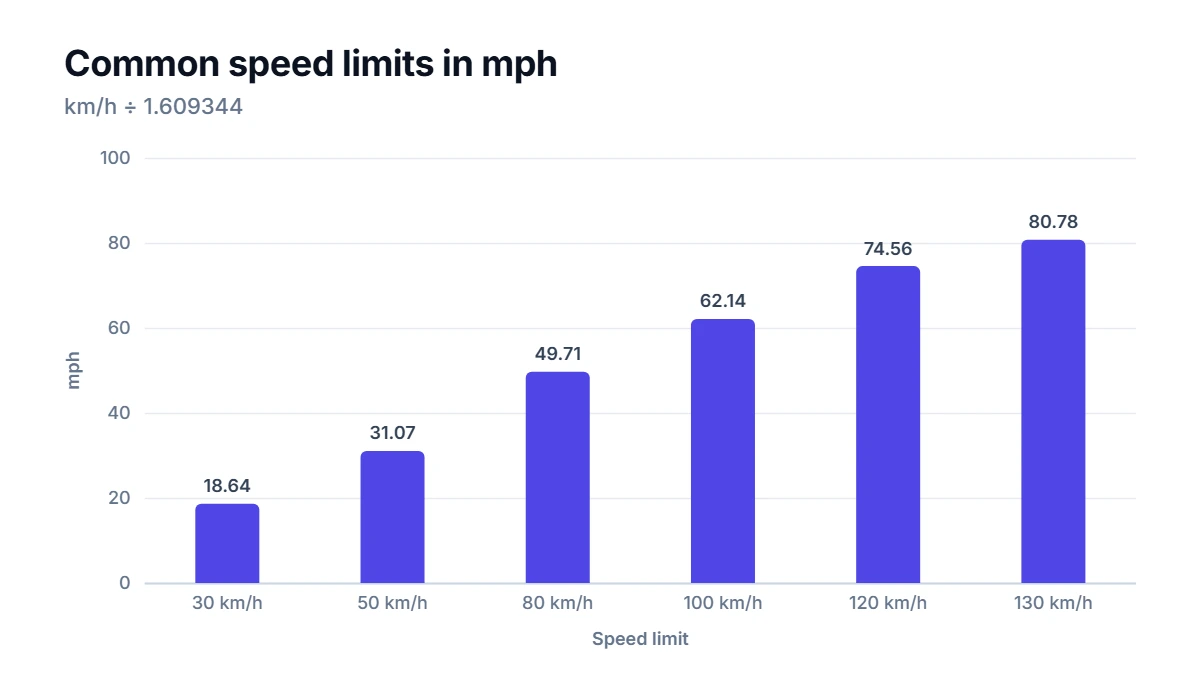
- 30 km/h ≈ 18.6 mph
- 50 km/h ≈ 31.1 mph
- 80 km/h ≈ 49.7 mph
- 100 km/h ≈ 62.1 mph
- 120 km/h ≈ 74.6 mph
- 130 km/h ≈ 80.8 mph
Going the other way, a US highway limit of 65 mph is about 104.6 km/h, and 70 mph is about 112.7 km/h. Limits change and vary by road type, so always follow the signs and check current local rules.
Mental math shortcuts
You rarely need six decimals while driving or reading the news. These approximations are close enough for everyday use:
- km/h to mph: multiply by 0.6, then add a little. 100 × 0.6 = 60, and the true answer is 62.1. Multiplying by 0.62 gets you within a fraction of a mile per hour.
- mph to km/h: multiply by 1.6. 30 mph × 1.6 = 48 km/h; the exact value is 48.28.
- km/h to m/s: divide by 3.6, or for a rough figure, divide by 4 and add 10%. 72 km/h ÷ 3.6 = exactly 20 m/s.
- m/s to mph: multiply by about 2.24. A 10 m/s wind is about 22.4 mph.
- knots to mph: add about 15%. 20 knots ≈ 23 mph.
Speed versus pace
Runners, walkers and cyclists often think in pace, the time per distance, rather than speed, the distance per time. They are inverses of each other:
- 10 km/h means 6 minutes per kilometer, because 60 ÷ 10 = 6.
- 12 km/h means 5 minutes per kilometer.
- 6 mph means 10 minutes per mile, which is about 9.66 km/h.
A brisk walk at 5 km/h is about 1.39 m/s or 3.11 mph. Convert to speed first, then use the speed converter if you need a different unit.
Wind, boats and aircraft
Weather services report wind in km/h, mph, m/s or knots, depending on the country and the audience. Marine and aviation forecasts nearly always use knots. A 20-knot breeze is 37.04 km/h or about 23.02 mph, strong enough for small sailboats to reef their sails. A jet cruising at 500 knots is moving at 926 km/h.
Using the Speed Converter
The Speed Converter handles all five units. Type a value, pick the unit you have and the unit you want, then press Convert. The swap button reverses the direction, and a table under the result shows the same speed in every unit at once, which is handy when you want to compare several units in one go. For 50 km/h, the table lists 13.888889 m/s, 31.06856 mph, 45.567221 ft/s and 26.99784 knots. The converter uses the exact definitions above, so there is no build-up of rounding errors.
Common mistakes
- Multiplying instead of dividing by 3.6. Remember that m/s numbers are always smaller than km/h numbers for the same speed.
- Mixing up statute and nautical miles. A knot is not the same as one mph; it is about 15% faster.
- Rounding too early. Using 1.6 instead of 1.609344 is fine for a quick estimate, but over long distances or exact work, use the full factor.
- Treating pace as speed. Doubling your pace in minutes per kilometer means going half as fast, not twice as fast.
FAQ
Why do planes and ships use knots?
Because nautical miles match the latitude and longitude grid on navigation charts, distances and speeds in knots fit naturally with chart work. The convention has stayed in use worldwide for safety and consistency.
How fast is 1 m/s in everyday terms?
1 m/s is 3.6 km/h or about 2.24 mph, a slow walking speed. A relaxed walk is usually around 1.2 to 1.4 m/s.
Is a car speedometer exact?
Usually not. Many speedometers read slightly high on purpose, and tire size and wear also affect them. A phone GPS reading is often a closer check of your real speed.
What is the difference between speed and velocity?
Speed is just how fast something moves. Velocity also includes the direction. For converting units the difference does not matter, since the same factors apply to both.
Related guides

How to Read and Write Roman Numerals
Roman numerals look like a puzzle, but they follow a few simple rules. Learn a reliable way to read any numeral from left to right, how to write years like 1888 and 2049, and how to spot forms that are not standard.

How to Convert Between Number Bases
Binary, octal, decimal and hexadecimal explained: how to read any base into decimal, how to convert decimal into any base by repeated division, and the quick binary-to-hex shortcut.

GB vs GiB: Data Storage Units Explained
Why a 2 TB drive shows about 1.82 TB on your computer, what the difference between GB and GiB really is, and how bits, bytes and internet speeds fit together.

Pressure Units Explained: psi, bar, kPa and More
psi, bar, kPa, millibars, inches of mercury and mmHg all measure the same thing. Learn what each unit means, how to convert between them and why gauge and absolute pressure differ.