How to Read and Write Roman Numerals
Roman numerals look like a puzzle, but they follow a few simple rules. Learn a reliable way to read any numeral from left to right, how to write years like 1888 and 2049, and how to spot forms that are not standard.

You see Roman numerals on clock faces, at the end of film credits, on building cornerstones, in book chapters and after the names of monarchs. Reading them can feel like decoding, especially long ones such as MDCCCLXXXVIII. In fact the system has only seven symbols and a few rules, and once you know a step-by-step way to read them, any numeral up to 3,999 takes seconds.
The seven symbols
- I = 1
- V = 5
- X = 10
- L = 50
- C = 100
- D = 500
- M = 1,000
A handy pattern: the symbols alternate between "ones" (I, X, C, M) and "fives" (V, L, D). Only the ones can be repeated, up to three times in a row.
The reading rule
Read the numeral from left to right and look at each symbol together with the one after it:
- If a symbol is smaller than the next one, subtract it.
- Otherwise, add it.
That is the whole algorithm. Here it is on MCMXCIV:
- M (1,000) is followed by C, which is smaller: add 1,000.
- C (100) is followed by M, which is larger: subtract 100.
- M (1,000) is followed by X: add 1,000. Running total: 1,900.
- X (10) is followed by C, which is larger: subtract 10.
- C (100) is followed by I: add 100. Running total: 1,990.
- I (1) is followed by V, which is larger: subtract 1.
- V (5) is last: add 5.
The total is 1,994.
Reading in chunks
With practice, it is faster to split a numeral into place-value chunks: thousands, hundreds, tens and ones. Each chunk uses only its own three symbols.
- Ones use I, V and X: I, II, III, IV, V, VI, VII, VIII, IX
- Tens use X, L and C: X, XX, XXX, XL, L, LX, LXX, LXXX, XC
- Hundreds use C, D and M: C, CC, CCC, CD, D, DC, DCC, DCCC, CM
- Thousands use M: M, MM, MMM
The patterns in each row are identical, just with different letters. Learn the ones row and you know them all.
Now MDCCCLXXXVIII splits into M | DCCC | LXXX | VIII, which is 1,000 + 800 + 80 + 8 = 1,888. And MDCLXVI, which uses every symbol once from largest to smallest, is M | DC | LX | VI = 1,666.
Writing a number as a Roman numeral
Writing works the same way in reverse. Split the number into place values, convert each digit using the rows above and join the pieces. Zero digits are simply skipped.
- 2049 = 2,000 + 40 + 9 = MM + XL + IX = MMXLIX
- 444 = 400 + 40 + 4 = CD + XL + IV = CDXLIV
- 3999 = MMM + CM + XC + IX = MMMCMXCIX, the largest standard numeral
Do not try to find a shortcut by subtracting across places. It is tempting to write 49 as IL (50 − 1), but the standard form treats the tens and ones separately: XL + IX = XLIX.
Why some numerals are longer than others
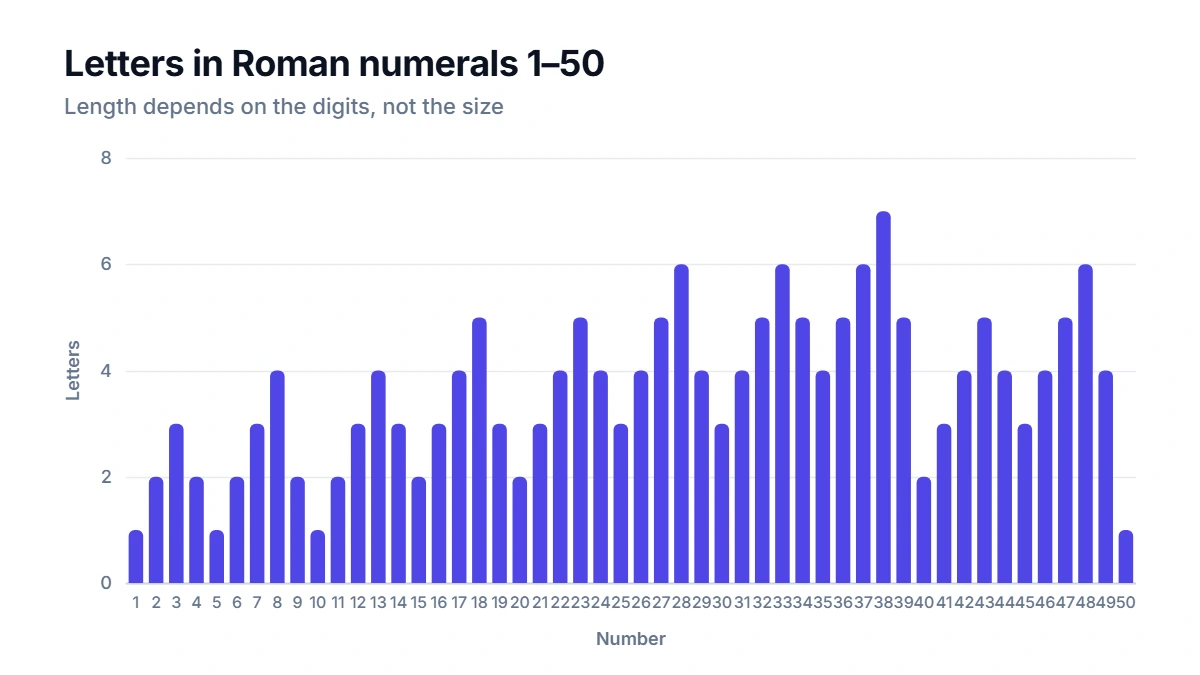
The length of a numeral has little to do with the size of the number. 50 is a single letter, L, while 38 needs seven: XXXVIII. Digits 4 and 9 cost two letters, 1 and 5 cost one, and 8 costs four. That is why 3,888, written MMMDCCCLXXXVIII, is the longest numeral in the standard range at 15 letters.
Spotting non-standard forms
The reading rule gives a value to almost any string of letters, even ones that are not written correctly. The Roman Numeral Converter checks every numeral by converting its value back and comparing the spelling. These are the usual culprits:
- IIII reads as 4, but the standard form is IV. Clock faces often use IIII, a long-standing design convention, but it is not the standard written form.
- VX reads as 5, which is just V. The fives (V, L, D) are never placed before a larger symbol.
- IC reads as 99, but the standard form is XCIX. I may only come before V and X, X only before L and C, and C only before D and M.
- IM reads as 999, which is properly written CMXCIX.
A quick test: in a standard numeral, a subtracted symbol is always one of I, X or C, and the symbol after it is at most ten times larger.
How to use the converter
Choose the direction in the Roman Numeral Converter: Number to Roman for whole numbers from 1 to 3,999, or Roman to number to read a numeral. Upper and lower case both work, and spaces are ignored. The result shows each place value separately, so you can check your own reading chunk by chunk. If you enter a non-standard form, the converter tells you the value it would have and the standard way to write it.
Where you will still see Roman numerals
- Years: copyright dates in film and television credits, and dates on buildings and monuments.
- Names: monarchs, popes and family names such as Henry VIII or John Smith III.
- Ordered sections: book volumes, chapters, acts of a play, and outline headings.
- Events: some sporting events and long-running series number their editions this way.
- Clock and watch faces, often with IIII for four.
FAQ
What is the fastest way to read a long Roman numeral?
Split it into chunks wherever a new place value starts, then read each chunk from the patterns above. For MMXXVI that is MM | XX | VI, or 2,000 + 20 + 6 = 2,026.
Is there a Roman numeral for zero?
No. The Roman system had no symbol for zero, and it is not needed because empty place values are simply left out. That is why 2,006 is MMVI, with nothing for the hundreds and tens.
Can Roman numerals be lowercase?
Yes. Lowercase numerals such as iv or xii are common for page numbers in book front matter and for list items. The rules and values are exactly the same.
Why is the same letter never repeated four times?
The subtractive forms IV, XL and CD keep numerals shorter and easier to read. Writing IIII or XXXX was used at times in history, but the modern standard limits each symbol to three repeats.
Related tools

Related guides

How to Convert Between Number Bases
Binary, octal, decimal and hexadecimal explained: how to read any base into decimal, how to convert decimal into any base by repeated division, and the quick binary-to-hex shortcut.

GB vs GiB: Data Storage Units Explained
Why a 2 TB drive shows about 1.82 TB on your computer, what the difference between GB and GiB really is, and how bits, bytes and internet speeds fit together.

Pressure Units Explained: psi, bar, kPa and More
psi, bar, kPa, millibars, inches of mercury and mmHg all measure the same thing. Learn what each unit means, how to convert between them and why gauge and absolute pressure differ.

How to Convert Volume Units (Metric, US and UK)
Liters, cups, fluid ounces and gallons all link back to the milliliter. Learn the simple two-step method, see worked kitchen and household examples, and avoid the US vs UK trap.