How to Convert Volume Units (Metric, US and UK)
Liters, cups, fluid ounces and gallons all link back to the milliliter. Learn the simple two-step method, see worked kitchen and household examples, and avoid the US vs UK trap.

Volume conversions turn up in the kitchen, at the gas pump, in the garden and at the pet store. A European recipe lists milliliters, your measuring cups are American, the aquarium is sold in gallons and the paint can is in liters. The good news is that every common volume unit is an exact multiple of the milliliter, so any conversion comes down to one multiplication and one division. This guide shows how the units fit together and walks through real examples.
Two systems, one bridge
Most of the world uses the metric system, where volume units step up in powers of ten and link directly to length:
- 1 milliliter (mL) = 1 cubic centimeter (cm³)
- 1 liter (L) = 1,000 mL, the volume of a cube 10 cm on each side
- 1 cubic meter (m³) = 1,000 L
The United States uses US customary units, which build up by doubling and other small multiples:
- 1 tablespoon = 3 teaspoons
- 1 fluid ounce = 2 tablespoons
- 1 cup = 8 fluid ounces
- 1 pint = 2 cups, 1 quart = 2 pints, 1 gallon = 4 quarts
The bridge between the two is the inch, defined as exactly 2.54 cm. A US gallon is defined as 231 cubic inches, which makes it exactly 3.785411784 liters. Every other US unit follows from that, so the conversions are exact rather than approximate.
The UK uses a third set, imperial units, which share names with US units but have different sizes. That is the source of many mistakes, covered below.
The method: convert through milliliters
To convert any volume by hand:
- Multiply the amount by the number of milliliters in the starting unit.
- Divide the result by the number of milliliters in the target unit.
The milliliter values you need most often are:
- US teaspoon: 4.93 mL
- US tablespoon: 14.79 mL
- US fluid ounce: 29.57 mL
- US cup: 236.59 mL
- US pint: 473.18 mL
- US gallon: 3,785.41 mL
- UK pint: 568.26 mL
- UK gallon: 4,546.09 mL
- Cubic inch: 16.39 mL
- Cubic foot: 28,316.85 mL
Worked examples
A 2-liter bottle in cups
2 L = 2,000 mL. Divide by 236.5882365 mL per cup and you get 8.45 US cups. So a 2-liter bottle of soda fills just over eight standard measuring cups.
A recipe that calls for 1.5 cups
1.5 × 236.5882365 = 354.88 mL. A metric measuring jug marked in 50 mL steps gets you close at 350 mL, which is fine for most cooking. For baking, where ratios matter more, measure to 355 mL.
How much water does a tank hold?
An aquarium is 24 inches long, 12 inches wide and 16 inches high. Its volume is 24 × 12 × 16 = 4,608 cubic inches. The Volume Converter turns that into 19.95 US gallons or 75.51 liters. That is why a tank of this size is sold as a 20-gallon tank. In practice it holds less water than that, because gravel, decorations and the gap at the top take up space.
A UK gallon in US gallons
Five UK gallons is 5 × 4.54609 = 22.73 liters. In US gallons that is 6.00 US gallons. The same number of gallons describes about 20% more liquid in the UK than in the US.
A wine bottle in fluid ounces
A standard 750 mL bottle is 750 ÷ 29.5735295625 = 25.36 US fluid ounces.
US vs UK: same names, different sizes
The imperial pint is 20 imperial fluid ounces, while the US pint is 16 US fluid ounces, and the two fluid ounces are not quite the same size either. The result is that UK pints and gallons are about 20% larger than their US namesakes:
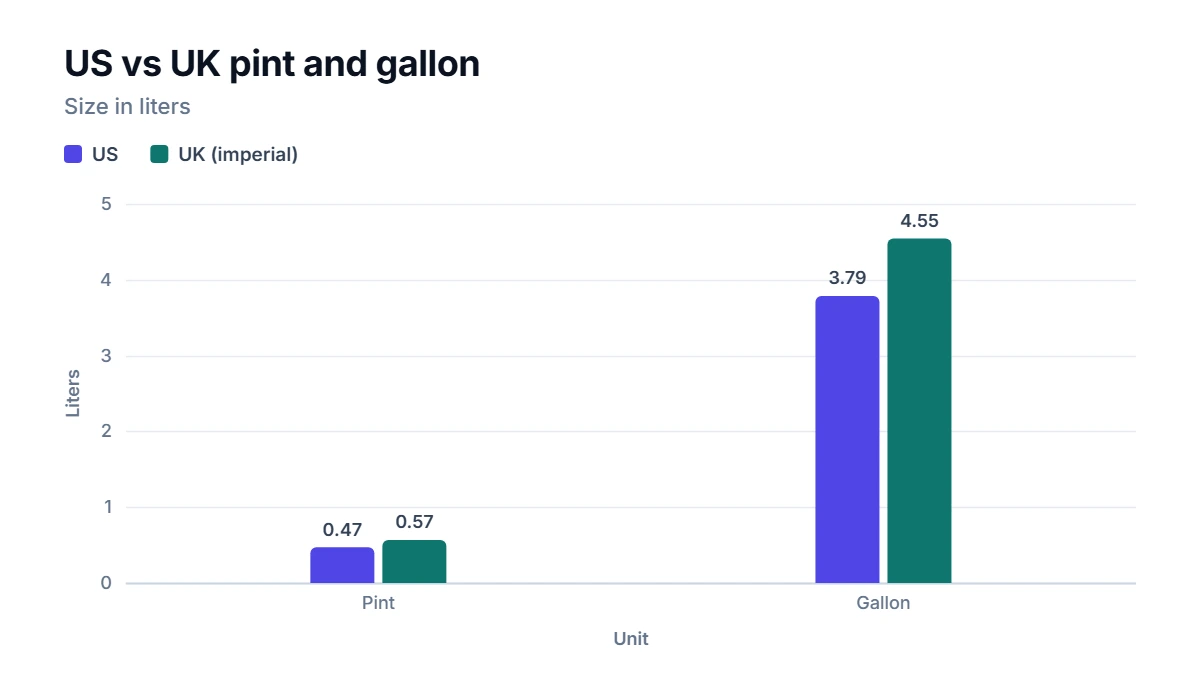
A practical example: 20 US fluid ounces is exactly 1.25 US pints but only about 1.04 UK pints. When a British recipe, a pub menu or a fuel economy figure says "pint" or "gallon", it means the imperial unit.
Common mistakes
- Confusing fluid ounces with ounces of weight. A fluid ounce measures volume; an ounce measures weight. They only line up for water and similar liquids, and even then only approximately. A cup of flour weighs far less than 8 ounces.
- Assuming all cups are equal. The US customary cup is 236.59 mL, US nutrition labels use a rounded 240 mL cup, and many other countries use a 250 mL metric cup. The difference is small for soup and noticeable for baking.
- Mixing up US and UK units. Always check where a recipe or specification comes from before converting pints, quarts or gallons.
- Using liquid units for dry ingredients in old recipes. The US also has separate dry pints and quarts, which are slightly larger than liquid ones. Most modern recipes use liquid measures, but older farm and gardening sources sometimes do not.
- Rounding too early. In a long chain of conversions, keep the full numbers until the last step, then round to what you can actually measure.
FAQ
Is a fluid ounce the same as an ounce of weight?
No. A US fluid ounce is a volume of about 29.57 mL. An ounce of weight is about 28.35 grams. A fluid ounce of water weighs roughly one ounce, but a fluid ounce of honey weighs much more and a fluid ounce of puffed rice much less.
How do I convert a volume to a weight?
You need the density of the substance. For water, 1 mL weighs about 1 gram, so 1 liter is about 1 kilogram. For anything else, multiply the volume by the density, or use a cooking converter that knows common ingredients.
How many cups are in a 2-liter bottle?
About 8.45 US customary cups, or exactly 8 metric cups of 250 mL.
Why does my car's fuel economy look different in UK sources?
UK figures in miles per gallon use the larger imperial gallon. The same car will show a higher mpg figure in the UK than in the US, even though it uses exactly the same amount of fuel.
Related tools

Related guides

How to Convert Kilograms to Pounds (and Other Weight Units)
The exact link between kilograms and pounds, quick ways to convert in your head, how stones and ounces fit in, and why the word "ton" can mean three different weights.

How to Read and Write Roman Numerals
Roman numerals look like a puzzle, but they follow a few simple rules. Learn a reliable way to read any numeral from left to right, how to write years like 1888 and 2049, and how to spot forms that are not standard.

How to Convert Between Number Bases
Binary, octal, decimal and hexadecimal explained: how to read any base into decimal, how to convert decimal into any base by repeated division, and the quick binary-to-hex shortcut.

GB vs GiB: Data Storage Units Explained
Why a 2 TB drive shows about 1.82 TB on your computer, what the difference between GB and GiB really is, and how bits, bytes and internet speeds fit together.