What Is CGPA? Scales, Calculation and Converting to a Percentage
CGPA sums up your whole academic record in one number, but the same figure means different things on a 4, 5 or 10-point scale. See how it is calculated, how it moves and why percentage conversions differ.

CGPA stands for cumulative grade point average. It condenses every graded term you have completed into one number, and that number shows up on transcripts, job applications and scholarship forms. The term is especially common at universities that use a 10-point scale, but the idea is the same everywhere: a credit-weighted average of your whole record so far.
GPA, SGPA and CGPA
The names vary between countries and institutions, so it helps to separate them:
- GPA usually refers to one term, although some schools use it for the overall figure as well.
- SGPA (semester grade point average) is one term's result, a name often used alongside CGPA.
- CGPA covers all terms so far and changes every time a new term is added.
If you are still working from individual course grades, you need a term GPA first. Once you have the term results, the CGPA calculation only needs two numbers per term: the GPA and the credits.
The calculation in one line
For each term, multiply its GPA by its credits to get its grade points. Add the grade points of all terms, then divide by the total credits:
CGPA = total grade points ÷ total credits
The weighting is what matters. A 24-credit term counts twice as much as a 12-credit term because it holds twice as much of your coursework.
A worked example: an eight-semester degree
Here is a full degree on a 10-point scale:
- Semester 1: 8.2 with 22 credits = 180.4 grade points
- Semester 2: 7.6 with 24 credits = 182.4
- Semester 3: 8.4 with 20 credits = 168.0
- Semester 4: 8.9 with 24 credits = 213.6
- Semester 5: 7.9 with 22 credits = 173.8
- Semester 6: 8.7 with 20 credits = 174.0
- Semester 7: 9.1 with 18 credits = 163.8
- Semester 8: 9.3 with 16 credits = 148.8
The total is 1,404.8 grade points over 166 credits, so the CGPA is 1,404.8 ÷ 166 = 8.46.
A plain average of the eight GPAs gives 8.51, which is slightly flattering. The two best semesters here were also the lightest, so they carry less weight in the true CGPA.
The gap can be much bigger when credit loads are lopsided. A 9.5 over 4 credits and a 7.0 over 24 credits average to 8.25 if you ignore credits, but the real CGPA is only 7.36.
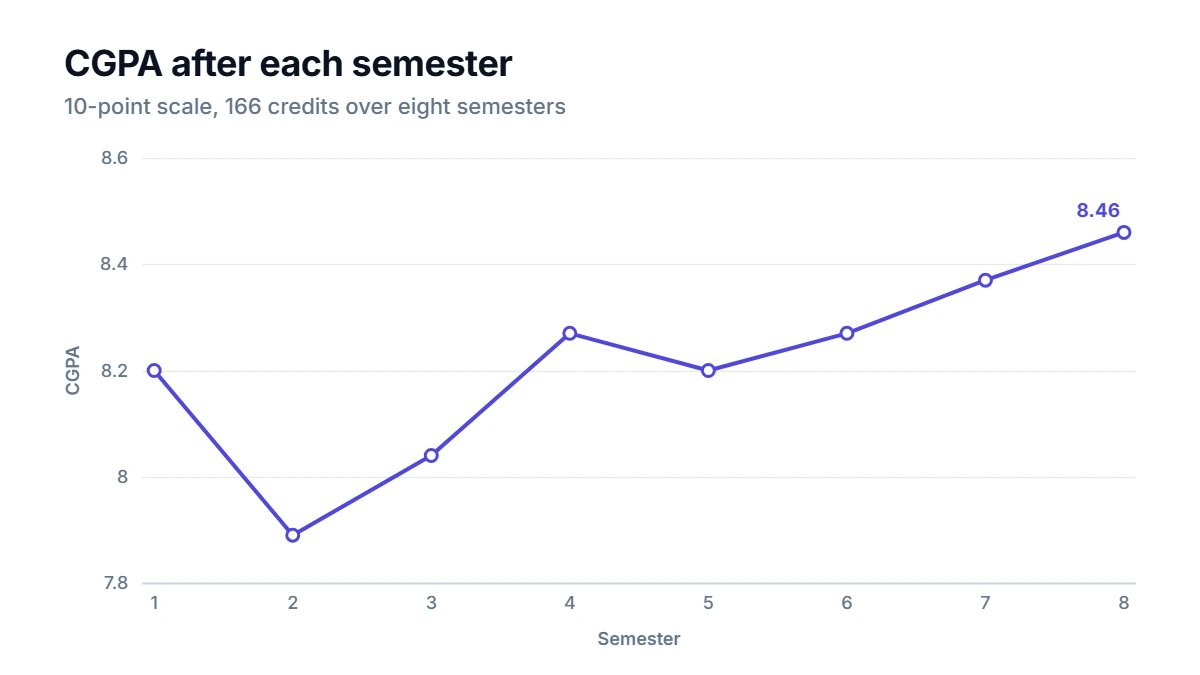
Follow the line and you can see how a CGPA behaves. It fell from 8.20 to 7.89 after one weak semester early on, but the 9.3 in the final semester only lifted it from 8.37 to 8.46. With 150 credits already behind it, even the best term has little room to pull the average.
Why the scale changes everything
A CGPA means nothing without its scale. An 8.0 is impossible on a 4.0 scale and only decent on a 10-point scale, while a 3.5 is strong on a 4.0 scale and very low on a 10-point one.
Scales also differ in how they map marks to points. Some institutions use a straight line from marks to points, while others use bands, where a whole range of marks earns the same grade point. Because of this, you cannot move between scales reliably by simple proportion. Multiplying our 8.46 by 0.4 gives 3.38 on a 4.0 scale, but a university's admissions office may evaluate the same record differently, or use a credential evaluation service with its own method. Treat a home-made conversion as a rough guide, and when an application asks for a specific scale, follow its instructions.
Converting CGPA to a percentage
This is the question that creates the most confusion, because there are several conventions:
- Simple proportion: divide by the scale maximum and multiply by 100. On a 10-point scale that means × 10, so 8.46 becomes 84.6%. On a 4.0 scale it means × 25, so 3.34 becomes 83.5%.
- The × 9.5 rule: common on 10-point scales, but set by particular boards and universities for their own grades. Here 8.46 becomes 80.37%.
- Institution formulas and tables: some universities subtract an offset before multiplying, and others publish a lookup table.
So one record can honestly be described as either 80.37% or 84.6%, a gap of more than four points. If a form asks for a percentage and your institution publishes a rule, use that rule and mention it. If it does not, say that the figure is an estimate.
How to use the CGPA Calculator
Choose your scale in the CGPA Calculator, then enter the GPA and credits for each term; the term names are optional. Press Calculate CGPA to see the result, the total credits and grade points, plus a table of your CGPA after each term. To convert the result, tick the percentage option and adjust the multiplier to match your institution's rule.
You can also use it for planning. Enter your record so far as one row, using your current CGPA and total credits, then add a row for a term you expect. With 8.46 over 166 credits and a further 20 credits at 9.5, the CGPA would become 8.57. Because the current figure is rounded, the result may differ slightly from your official one.
Mistakes to watch for
- Mixing scales. After a transfer or exchange, terms may be reported on different scales. Convert them using your institution's rule before combining them.
- Mixing kinds of credit. Semester hours and ECTS credits are not the same size. Use one kind for every term.
- Rounding too early. Rounding each term before you combine them can shift the result by a hundredth or two. Exact grade points give the cleanest answer.
- Forgetting repeats. Some institutions replace a failed course's grade after a retake, and others keep both attempts. Check how yours treats them, as this can change your official figure.
FAQ
Is a higher CGPA scale better?
No. A 10-point scale is not more generous than a 4.0 scale; it simply uses a different range. Compare results only after converting them using a method the reader accepts.
What is a good CGPA?
It depends on the scale, the institution and your goal. Honors classes, scholarships and employers each set their own cut-offs, so look up the specific requirement rather than relying on a general figure.
Can my CGPA change after I graduate?
Normally not, since it is fixed once your final record is issued. It can change if the institution corrects a grade or processes a late result, so check the final transcript.
How can I raise my CGPA quickly?
The biggest lever is earning high grades in the terms with the most credits, and doing it early, when fewer credits are on your record. Late in a degree, even an excellent term moves the figure only slightly.
Related tools


Related guides

How to Calculate Your GPA (and How to Raise It)
GPA is a credit-weighted average, which is why one heavy course can move it more than three light ones. Learn the method, work through a real example and see how much a strong term can lift your cumulative GPA.

How to Calculate Percentages
Percent of a number, what percent one number is of another, and percentage change: three simple methods with worked examples, plus why two discounts never add up the way you expect.

How to Scan a QR Code Safely, With or Without a Phone
A QR code can hide any link, and you only see it after you scan. Learn how to scan from a camera or a screenshot, read what a code really contains, spot a fake one and fix a scan that fails.

How to Calculate the Gas Cost of a Road Trip
Three numbers tell you what a drive will cost in fuel: distance, fuel economy and price. Learn the formula in MPG and L/100 km, work through a real trip and see why fuel economy gains matter most at the low end.